
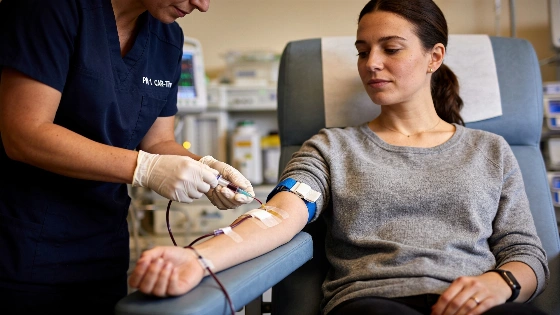
Anixa Biosciences has dosed a second patient in the fifth cohort of its Phase 1 CAR-T trial for ovarian cancer at Moffitt Cancer Center. This is the highest dose the company has tried so far. The step pushes the program into new ground and puts Anixa’s high-flying valuation under a sharper lens.
The company confirmed the news in an official statement. The trial, listed as NCT05316129, is testing a CAR-T/CER-T therapy that targets the follicle-stimulating hormone receptor (FSHR). This receptor is found mostly on ovarian tumor cells and shows little presence in healthy tissue. More details are in a BioSpace clinical update.
As of July 2026, five patients in Anixa's ovarian cancer CAR-T trial had survived more than a year post-treatment, with the longest follow-up reaching approximately 28 months.
Anixa’s Price-to-Sales ratio sits at 225.5 times its historical median. That’s sky-high. The company’s $102 million market cap is built on pipeline hopes, not sales. There are no profits. Standard earnings metrics like P/E don’t apply. The only thing that matters now is whether its FSHR-targeted CAR-T can help patients who have run out of options.
Insider bets and market signals
Anixa’s leaders are buying in. Over the last year, insiders picked up $0.5 million in shares. No one has sold. The company’s current ratio is 8.55. Debt is low. Its momentum score is a perfect 10 out of 10 on the GF Score™. But the same system gives Anixa just 2 out of 10 for valuation. The total GF Score™ is 37 out of 100. That shows the company is unproven and risky.
Regulatory filings show that in late September 2026, Anixa’s CEO and a director bought $19,460 and $131,906 in shares. They’re still betting on the company. The trial is run at Moffitt Cancer Center by Dr. Robert Wenham, Chair of the Gynecologic Oncology Program. This is confirmed in the official clinical announcement.
Trial progress and clinical context
The Phase 1 trial at Moffitt is focused on safety and dosing for Anixa’s CAR-T in recurrent ovarian cancer. This cancer is tough to treat. Few options exist. In the fifth cohort, patients get 1×10⁷ CAR-positive cells per kilogram after lymphodepletion. That’s the highest dose in the study so far. As of the latest update, no dose-limiting toxicities have been seen in any group. The first patient at this top dose also had no major side effects.
Anixa’s pipeline stretches beyond ovarian cancer. It works with the Cleveland Clinic on breast, lung, colon, and prostate cancer research. Still, the company’s future hangs on the ovarian cancer CAR-T trial. The market is betting big on the science. There’s no real revenue yet. A recent market analysis looks at how CAR-T developers face similar high-stakes risks.
The Phase 1 trial is evaluating FSHR-targeted CAR-T/CER-T therapy for recurrent ovarian cancer, with FSHR expression largely restricted to tumor cells and minimal presence in healthy tissues.
Editorial analysis
Anixa Biosciences is a classic example of clinical-stage biotech risk. The numbers don’t justify the price. Insider buying shows some faith, but big investors are cautious. The real answer will come from the clinic. Until larger trials prove safety and benefit, Anixa’s value is just a bet on risk. The next big news won’t come from earnings reports. It will come from trial results. Only then will the market know if Anixa’s CAR-T gamble pays off.