
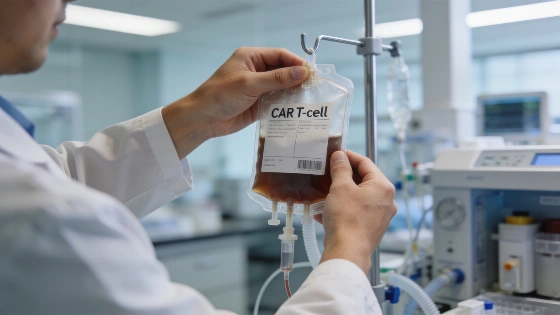
Immix Biopharma has put itself at the front of the fight against relapsed or refractory AL amyloidosis. Its CAR T-cell therapy, NXC-201, delivered an 89% complete response rate in treated patients. There are still no FDA-approved therapies for this group. Immix is now preparing NXC-201 for a biologics license application and a targeted launch.
NXC-201 has received orphan-drug status from both the FDA and the European Medicines Agency, reflecting its potential to address a rare and serious disease.
Clinical evidence and safety profile
President and CFO Gabriel Morris reported that 44 of 45 patients treated with NXC-201 saw their toxic light chains return to normal. Forty out of 45—an 89% rate—reached a complete response. The company thinks this could rise to 98%. Four patients are now minimal residual disease (MRD) negative and may convert to complete response with more follow-up. In the 25 most recent patients, all were either in complete response or MRD negative. Every previously reported MRD-negative patient has later reached complete response. The median time to conversion was about two months. Some took as long as 320 days.
Organ response data added more support for NXC-201. Evaluable patients had a 100% cardiac response rate and a 92% renal response rate. Cardiac improvements showed up as early as 26 days after dosing. The overall organ-response rate was 95%. On safety, the median duration of cytokine release syndrome (CRS) was just one day. No high-grade CRS, neurotoxicity, or enterocolitis was reported. Rachman said short CRS duration matters for patients with heart and kidney problems.
Regulatory and commercial strategy
NXC-201 already holds Breakthrough Therapy and Regenerative Medicine Advanced Therapy (RMAT) designations. An official SEC regulatory filing from September 29, 2026, confirmed the interim update from the NEXICART-2 study. All 45 enrolled relapsed/refractory AL amyloidosis patients were included, and the 89% complete response rate was confirmed. Immix calls NXC-201 a potentially registrational therapy in the U.S. Phase 2 NEXICART-2 study. This study is the basis for its planned FDA submission.
The NEXICART-2 trial is a multicenter U.S. Phase 2 study enrolling 45 patients with relapsed or refractory AL amyloidosis. In addition to Breakthrough Therapy and RMAT designations, NXC-201 has also received orphan-drug status from both the FDA and EMA, and Immix recently completed a $125 million stock offering at $11 per share to support further development.
Immix plans to launch a randomized frontline trial in 2027. The study will compare NXC-201 to the current standard of care, daratumumab plus CyBorD. It will follow the ANDROMEDA trial model. About 260 patients will be enrolled. Interim analysis will focus on complete response rates.
Market access and physician adoption
Chief Commercial Officer Michael Grabow said market research among hematologist-oncologists treating relapsed or refractory AL amyloidosis showed a big unmet need. Many doctors said they would likely prescribe NXC-201, depending on data expected at ASH 2025. Immix estimates that about 2,800 hematologist-oncologists account for 90% of AL amyloidosis claims. Many are already linked to FACT-accredited centers with CAR T experience.
The company’s commercial plan is tight. Immix expects to bring on 60 to 70 treatment centers. It will deploy a lean field team of 35 to 45 CAR T account managers. The focus is on sites already familiar with CAR T therapy. Pricing for NXC-201 is not set. It will only be decided if the therapy is approved. The company is weighing input from doctors, payers, centers, and patients. Management thinks the efficacy and safety could support premium pricing, but no numbers have been shared. A recent capital raise has extended Immix’s cash runway into the first quarter of 2029, assuming no revenue.
Similar high response rates in AL amyloidosis have been covered in OncLive reporting. This shows the competitive field and the weight of Immix’s latest results.
Immix Biopharma is moving fast on both clinical and commercial fronts. The company wants to turn strong early data into regulatory and market success. If NXC-201’s results hold up with longer follow-up and FDA review, the therapy could change the outlook for relapsed or refractory AL amyloidosis. It could set a new standard for CAR T-cell therapy in this area. The next year will show if Immix can turn these numbers into a real breakthrough for patients and a viable product.