
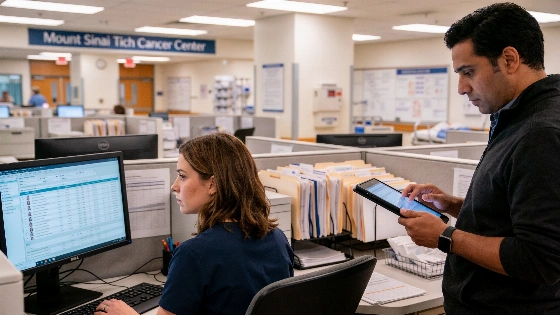
At Mount Sinai Tisch Cancer Center, research teams no longer waste hours retyping patient data. That changed with the arrival of real time EHR-to-EDC integration. Now, every new clinical trial at the center runs with automated data flow built in. The old days of manual entry are gone.
Instead of copying details from Epic EHR into trial databases, staff use IgniteData’s Archer platform. The system moves structured clinical data straight into the electronic data capture systems that run the studies. The impact is clear. Average data entry time per patient visit dropped from 5.5 minutes to 2.5 minutes. That’s more than a 50 percent cut. In reviewed cases, the system hit 100 percent accuracy. No follow-up queries needed. Zero errors so far.
After its 2025 launch, the EHR to EDC solution was activated across all 16 disease groups at Tisch Cancer Center, making automated data flow a standard part of every new clinical trial.
Automated data flow now standard
This is not a test run. Since 2025, Archer integration covers all 16 disease groups at Tisch Cancer Center. That includes breast, lung, myeloid leukemia, and multiple myeloma. Every new trial starts with automated data flow as a default. It’s not an upgrade. It’s the baseline. About 70 percent of the data needed for electronic case report forms now fills in automatically at each patient visit. That’s according to an official Mount Sinai press release.
For research staff, the change is immediate. Alex Lieberman-Cribbin, Clinical Trials Manager at the Icahn School of Medicine at Mount Sinai, put it simply: “This technology is making a real difference in the day-to-day work of clinical research teams. By reducing the amount of time spent on manual data entry, we can focus more of our time on study coordination, patient care, and making sure our clinical trials run as efficiently as possible.”
Better data, faster work
Manual EHR-to-EDC transfer always meant errors and delays. Each keystroke risked a mistake. Fixing those mistakes took time. Automation changed that. Now, Epic sends structured data straight to trial systems. The process that once took days or weeks now happens almost instantly. Highly trained staff spend less time on paperwork and more on real research. Mount Sinai confirms that duplicate manual entry is gone. The risk of transcription errors is down.
Data quality has jumped. It was a weak spot before. IgniteData CEO Zach Taft explained: “IgniteData is focused not just on moving data but moving the data that matters. Our commitment to sites and sponsors is to seamlessly transfer the data required for clinical trials in the required formats. This ensures data is consistent, accurate, and tracible – ultimately fueling more efficient clinical trials.”
Mount Sinai reports that automation is now being extended beyond basic visit data to include medical history, concomitant medications, and efficacy laboratory metrics, further broadening the workflow for clinical research teams.
The system does not just dump all EHR data into trial databases. It targets only the fields needed for each study. Each field is formatted for downstream monitoring and regulatory review. Research teams are not buried in irrelevant data. Mount Sinai now treats automated data collection as a core part of its research model. Integration is included in every new protocol. More data types are coming online.
Moving into complex data and advanced therapies
Mount Sinai is pushing further. The center is expanding EHR-to-EDC integration to cover complex data types. That includes real world medical history, concomitant medications, and efficacy lab data. These are harder to automate than the simple fields handled at first. The program now supports cellular therapies like CAR-T cell therapy. These trials need fast, detailed data handling.
This push is backed by Mount Sinai Tisch Cancer Center’s status as a National Cancer Institute designated comprehensive cancer center. The center has a mandate to build research infrastructure and open access to new trials. By making automated data collection standard, Mount Sinai is raising the bar for research speed and data quality.
This is not just a tech upgrade. It’s a shift in how clinical research works. Manual double entry is gone. Automation is now part of every new trial. The system is expanding into complex therapies. Other centers can follow this model. As paperwork grows, Mount Sinai’s results show that retyping hospital charts is on the way out. For those ready to change, the path is clear.