
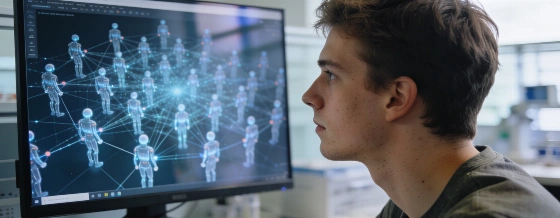
Stanford’s virtual biotech company didn’t just theorize about drug discovery—it independently suggested a lung cancer therapy that a major pharmaceutical company would later pursue, months before the company’s own breakthrough. The system’s 37,000 AI agents worked in parallel, analyzing clinical trial data, picking out likely drug targets, and designing therapeutic strategies at a speed and scale far beyond what any human team could manage.
The Virtual Biotech system analyzed 55,984 clinical trials, uncovering that drugs targeting cell-type-specific genes were 48% more likely to reach the market and had 32% fewer adverse events.
When asked to build on research linking genetic evidence to drug trial success, the virtual CSO focused on data quality. It sent its agents to review the outcomes of 37,075 Phase II and III trials, assigning one agent per trial. In just six hours, these agents combed through registries, scientific papers, and press releases, pulling together results that would have taken human researchers months or years to collect.
The next step was to find gene targets with the best odds of clinical success. By analyzing gene expression patterns—specifically, whether a gene is active in a narrow set of cell types and whether its activity acts like a switch or a dimmer—the AI agents found a clear trend. Drugs aimed at switch-like genes found in limited cell types were 48 percent more likely to reach the market, 40 percent more likely to move from Phase 1 to Phase 2, and had 32 percent fewer adverse events compared to drugs targeting broadly active genes. According to a peer-reviewed study in Science, this large-scale analysis was possible only by using over 37,000 AI agents working together.
Stanford Medicine describes the Virtual Biotech project as a digital company built in the labs of James Zou and Harrison Zhang, simulating the entire drug development pipeline by dividing AI agents into specialized blocks for target discovery, safety assessment, modality selection, and clinical development.
James Zou, the study’s senior author, called this “really exciting as an independent, third-party validation that’s consistent with the effects and the design proposed by the virtual biotech.” The AI system’s ability to land on a real-world therapeutic strategy, using only pre-2025 data, shows its potential to change how drug targets are found and prioritized. As noted in a Nature analysis, the Virtual Biotech system is a step toward AI that can handle complex, multi-stage research tasks on its own, with its scale and predictive power offering new ways to forecast clinical trial success.
Still, even with these advances in candidate selection, the AI cannot shorten the time or cost of lab and clinical testing. The slow pace of human trials remains. But in a field where 90 percent of clinical candidates fail and key evidence is scattered across disciplines, a virtual biotech team that can quickly surface the most promising targets is a major shift. The results from Stanford’s experiment are clear: AI-driven collaboration at this scale can transform the earliest, riskiest stages of drug discovery, giving drug developers a sharper edge in bringing new therapies to patients.