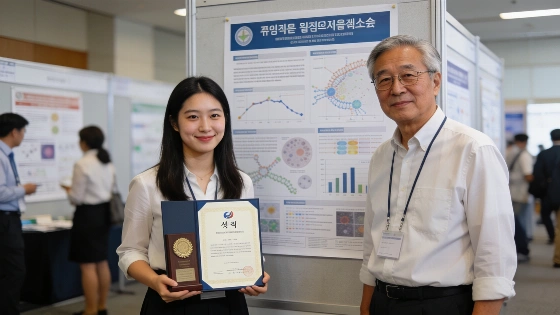
Lee Seung-yeon walked onto the stage at the Korea Genome Organization's 35th international conference. She picked up the excellent poster award. This was not just another prize. Her work showed a new way to handle the flood of omics data that overwhelms many scientists.
Her project centers on Q-omics, an AI platform built to cut through the noise of millions of molecular measurements. Old bioinformatics tools often choke on this scale. Q-omics does not. It finds drug targets and biomarkers automatically. No more wrestling with slow computers or endless code. The platform points straight to the genes and proteins that matter for new medicines.
The Korea Genome Organization (KOGO) has been hosting its annual conference for over three decades, serving as a key venue for presenting the latest research in genomics and bioinformatics.
Q-omics stands out for one reason. It weaves a biological ontology right into the AI's learning. The platform does not treat genes as lone actors. Instead, it learns how genes work together in real life. This lets it map gene networks and spot clusters—groups of genes that move as a team in certain diseases. The result is a sharper, more complete view of how diseases work and where to intervene.
Lee is a master's student in the Department of Biological Sciences at Sookmyung Women's University. She built Q-omics with guidance from Professor Yoon Suk-joon. The university says the platform is meant to open omics analysis to more people. Researchers do not need to be coding experts. They can still get deep insights into disease biology and drug response.
The Korea Genome Organization's annual conference is where new ideas in genomics and bioinformatics get tested. Lee's award there shows how far AI-driven research has come. Her poster, "Biological intelligence for target, biomarker and mechanism discovery from omics data," drew attention from academic leaders. Kim Tae-min, vice chair of the Korea Genome Organization's academic committee, was among those who took notice.
Omics data encompasses large-scale measurements of cellular molecules, including genes and proteins, providing a comprehensive view of biological systems that is essential for modern biomedical research.
By building biological knowledge into machine learning, Q-omics breaks past the limits of single-gene analysis. It makes it easier to spot what drives disease and where new treatments might work. Sookmyung Women's University expects this approach to speed up drug target discovery, sharpen biomarker searches, and make sense of how diseases progress and how drugs act at the molecular level.
This award is not just a personal win for Lee Seung-yeon. It signals a shift in genomics. The future will belong to those who can blend biology with computing. As AI platforms like Q-omics get better, the real challenge in drug discovery will not be making data. It will be making sense of it. The next breakthroughs will come from people who can turn complexity into clear answers.