
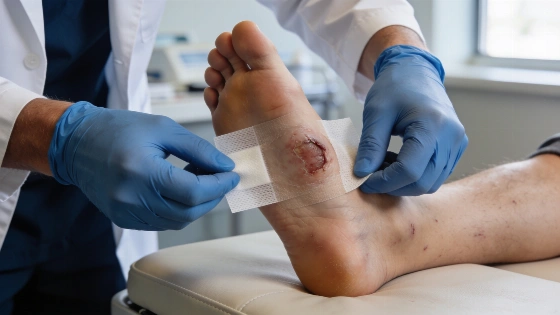
Symphony changed the numbers for diabetic foot ulcers. In a US multicentre trial, Aroa Biosurgery’s wound care product closed 55% of ulcers when used with standard care. Standard care alone closed just 35%. The trial enrolled 143 patients at 10 sites. That’s a solid dataset. The results leave little doubt about Symphony’s effect.
Kaplan–Meier analysis from the International Wound Journal study demonstrated that Symphony (OFM-HA) plus standard care not only improved healing rates but also accelerated time to wound closure compared to standard care alone.
Patients on Symphony healed faster. The average time to full wound closure dropped by 7.8 days. That’s 65.4 days for Symphony, compared to 73.2 days for standard care. These findings, published in the International Wound Journal, focused on Wagner Grade 1 and Grade 2 diabetic foot ulcers. These range from full-thickness skin wounds to deeper injuries that reach ligaments and tendons.
Clinical evidence and product details
Symphony was applied weekly with standard care for up to 12 weeks or until wounds closed. The improvement was statistically significant. The International Wound Journal also reported similar rates of adverse events. Half of the Symphony group and 51% of the control group had at least one event over 12 weeks. That suggests Symphony does not add safety risk.
A recent meta-analysis of nine randomised trials involving 944 participants found that placental-derived CAMPs increased the likelihood of complete diabetic foot ulcer closure at 12 weeks to 59.0% compared to 35.8% in controls, with a pooled relative risk of 1.70 (95% CI 1.31–2.20).
Symphony is built as a skin substitute for tough wounds. That includes diabetic foot and venous leg ulcers. The product combines AROA ECM—Aroa’s own extracellular matrix from sheep forestomach tissue—with high molecular weight hyaluronic acid. This acid is known for fighting inflammation and holding water. Aroa says Symphony is the only product in its class with high molecular weight hyaluronic acid on the market.
Company background and market context
Aroa Biosurgery started in 2008 in Auckland, New Zealand. The company makes and sells products for complex wound healing and soft tissue repair. Its reach is global. More than 7.5 million devices have been used worldwide. The US is a key market, with direct sales and a distribution deal with TELABio. The AROA ECM platform is the base for all its products. The goal is to tackle stubborn wound care problems.
Symphony’s clinical proof is a big step for Aroa. But the wound care field still faces storage and logistics hurdles. As reported earlier, work continues to improve cell therapy storage. Strong clinical data and new biomaterials give Aroa a shot in a crowded market. The real test is ahead. Will US hospitals adopt Symphony and will insurers pay? The trial results are now public. Aroa has a strong case for clinical value. But future success depends on turning data into sales and better outcomes for patients.