
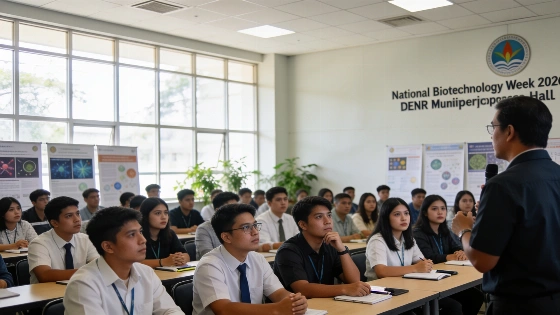
As National Biotechnology Week 2026 wrapped up in Quezon City, the message was blunt: Philippine agriculture can’t stick to old ways if it wants to survive climate change. The forum, "Cultivating Resilience: A Forum on Ag-Biotech Solutions for Climate-Smart Agriculture," drew a crowd of scientists, policymakers, and students who tackled the urgent need for new tools as El Niño and other climate threats ramp up.
ISAAA Deputy Director Panfilo De Guzman didn’t mince words. He told the crowd, "Achieving these ambitious goals requires more than good intentions and traditional methods. It demands cutting-edge innovations. These innovations can be created using modern biotechnology tools." For De Guzman, climate-smart agriculture means more than a slogan. It’s a call to bring real technology into the field to protect food, jobs, and the environment.
In the Bicol region, El Niño has already caused agricultural losses amounting to 235.8 million pesos, affecting over 8,000 farmers, with rice accounting for 81% of the damage.
Biotech as the engine of adaptation
Agnes Catherine Miranda, who heads the Department of Agriculture’s Climate Resilience Office (CRAO) and the Adaptation and Mitigation Initiative in Agriculture (AMIA), laid out the stakes. She described a sector already battered by climate swings, with El Niño putting pressure on farmers and fisherfolk. Miranda said the Department’s answer isn’t a single fix. Instead, it’s a push across programs and regions to help those who grow the country’s food get ready for what’s coming.
Back in October 2026, the government started gearing up for a new El Niño event. Officials say it began that month and could stretch through March 2027. President Ferdinand Marcos ordered the Department of Agriculture to roll out a full support plan for farmers and fisherfolk, bracing for big hits to food security and rural incomes, as detailed in an official government announcement.
Dr. Leilani Pelegrina, who leads the Crops Research Division at DOST PCAARRD, broke down what agri-biotech really means. It’s not just about new seeds. It’s about changing how research and development works from the ground up. She pointed out that biotech can speed up breeding, make traits more accurate, and shift the approach from reacting to problems to managing them with data. DOST-PCAARRD’s programs—like the Industry Strategic Science and Technology Programs (ISPs) and the Harmonized National Research and Development Agenda (HNRDA)—now target resilience and productivity, especially in the crops sector.
In the MIMAROPA region, the Department of Agriculture is preparing drought-tolerant rice varieties and alternative crops for areas at risk of losing their rice planting season due to water shortages, with over 147 million pesos allocated for seeds, planting materials, fertilizers, and pesticides.
From policy to practice
The panel, led by Dr. Jaime Manalo IV of PhilRice, got into the nuts and bolts: how AMIA Villages are modeling adaptation, the mental health strain on farmers, and the promise of robotics and AI-driven tech. The group didn’t dodge tough questions. They pressed on how to turn policy into real gains for farmers and how to make sure new technology actually lands in the hands of those who need it.
Across the Philippines, regional offices of the Department of Agriculture are already rolling out climate adaptation steps. These include crop diversification, handing out heat- and drought-tolerant seeds, and using water-saving tools. In Cagayan Valley, for example, officials are recommending root crops, peanuts, legumes, and other dry-season crops to help farmers adjust, as outlined in a regional adaptation report.
The spotlight wasn’t just on officials and scientists. The Biotech for Reel Competition recognized students whose projects ranged from cultured mushrooms and tofu to Bt crops and CRISPR-Cas9. Winners from San Mariano National High School and Cavite Science Integrated School - Regional Science High School took home plaques and cash prizes. Special awards went to other standout student projects, showing the next generation is already stepping up.
Sector collaboration and what’s next
The event brought together the Department of Environment and Natural Resources (DENR) as host, with support from DOST, DA, DOH, DILG, DTI, CHED, and DepEd. In closing, Mr. Pian Huelva, speaking for Dr. Paul Limson of DA-BPO, drove home the point: the future of Philippine agriculture is a team effort. Policymakers, experts, teachers, and young leaders all have to pull their weight.
Anyone who missed the forum can watch the full recording on ISAAA Inc.'s Facebook page. Know the Science PH is also sharing updates and highlights from the Biotech for Reel winners on social media. The push for climate-smart, biotech-powered farming is picking up speed, echoing the kind of cross-sector innovation seen in other areas—like the recent push for room-temperature cell therapy storage.
This year’s National Biotechnology Week left no room for doubt. Philippine agriculture is at a turning point. Talk of resilience isn’t enough anymore. Only by putting biotechnology at the heart of policy, research, and education can the country hope to keep up with climate change. The forum’s message was clear: innovation can’t wait.