
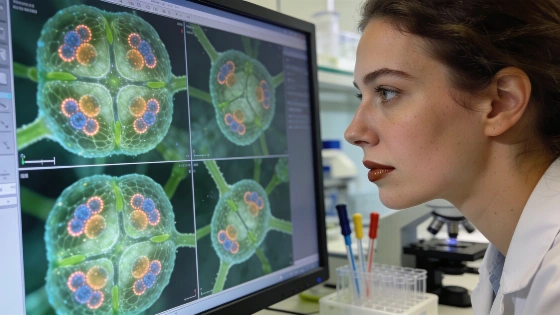
Centromeres are the parts of chromosomes that make sure genetic material splits correctly when cells divide. For years, scientists thought these regions barely changed. That idea just hit a wall. A team from Heinrich Heine University Düsseldorf and the Max Planck Institute for Plant Breeding Research found something surprising. Centromere DNA mutates much faster than the rest of the genome. Yet it still works.
The genome of Arabidopsis thaliana was first published in Nature in December 2000, marking a milestone in plant genomics and establishing the species as a key model organism for genetic research.
Small changes, big patterns
Professor Dr Korbinian Schneeberger led the team. They found these mutations don’t just scramble the DNA. In Arabidopsis, centromeres are built from a 178-letter DNA sequence repeated thousands of times. Most insertions and deletions add or remove whole repeat units. This keeps the overall pattern. Computer models running thousands of generations showed something else. Even small changes, stacked up over time, can build the huge, nearly identical blocks of repetitive DNA seen in real centromeres. Some of these stretches run for millions of DNA letters.
Xiao Dong, first author and doctoral researcher at the Max Planck Institute for Plant Breeding Research, put it simply. “Centromeres are far more dynamic than one might expect for a region of the genome with such an essential function.” Dong said the mutations happen often, but they are organized. The core repetitive structure stays in place.
The centromere paradox
Research groups at Heinrich Heine University Düsseldorf and the Max Planck Institute for Plant Breeding Research have been at the forefront of centromere and repetitive DNA studies, contributing to the understanding of genome organization in plants.
Professor Detlef Weigel from the Max Planck Institute for Biology Tübingen, a co-author, said centromeres stand out when comparing genomes. Their odd mutation patterns make them unique. The research links small, generation-by-generation changes to the big differences seen in centromeres across species and populations.
This study shows centromere DNA can change a lot without losing its main job. It breaks the old link between genome stability and DNA sequence staying the same. The genome can bend and adapt, even in its most basic parts. For genomics and evolutionary biology, this means scientists need to rethink how key genetic elements evolve. Their function may be tougher than anyone thought.