
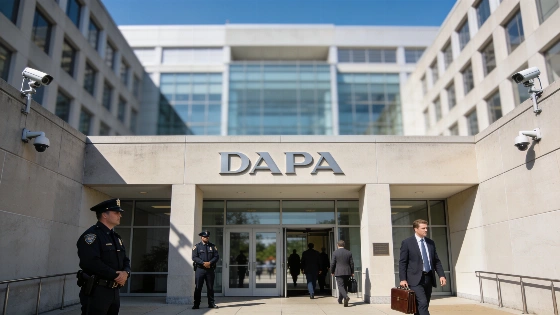
DARPA is raising the stakes in military biotech. The agency now insists that artificial intelligence must run through every layer of its program management. Systems Planning and Analysis (SPA), based in Alexandria, Virginia, just landed a $10.9 million contract to support DARPA’s biotechnology work. The job comes with one clear rule: AI must be built in from the ground up.
This isn’t just talk. The contract runs until October 2031. SPA will handle technical, administrative, program, and financial management for both new and ongoing biotech projects. But the official notice keeps the details locked down. There’s no word on which tasks AI will take over, what software will be used, or if DARPA is picking specific AI tools. Only one thing is certain. AI is now central to the process.
DARPA’s Biological Technologies Office issued a major solicitation in October 2025 seeking proposals in AI and machine learning for biology, combat casualty care, human performance under extreme stress, and bio-inspired materials and sensors.
Inside the contract and DARPA’s biotech ambitions
SPA will work out of DARPA’s Arlington, Virginia headquarters. The agency has already committed $3.9 million in fiscal 2026 research, development, test, and evaluation funds. The contract uses a cost-plus-fixed-fee and award-fee structure. SPA gets reimbursed for costs, a fixed fee, and can earn more if DARPA rates their work highly. Three companies competed for this job. SPA came out on top.
DARPA’s model is different. The agency doesn’t run its own labs. Instead, it relies on program managers to fund outside teams at universities, labs, and companies. Support contractors like SPA are key. They handle engineering, science, finance, and acquisition. For biotech, SPA will be the main support. The notice didn’t name the specific DARPA office, but the Biological Technologies Office has led these efforts before. In October 2025, that office put out a call for proposals in AI and machine learning for biology, combat casualty care, human performance under extreme stress, and bio-inspired materials and sensors. The deadline was September 30.
DARPA’s approach to biotechnology program management relies on external performers and support contractors, rather than in-house laboratories, to drive innovation and operational efficiency.
SPA’s track record and the stakes for defense biotech
SPA knows DARPA well. In 2023, SPA was one of six firms picked for the Technical and Analytical Support Services II contract. That’s a five-year deal with a $1.25 billion ceiling for advisory work across all DARPA offices. Earlier this year, SPA also won a five-year, $151.4 million contract to support DARPA’s Information Innovation Office, which handles AI and cyber programs. SPA, founded in 1972 and owned by Arlington Capital Partners, has nearly 3,000 employees. The company is deeply tied to U.S. defense analysis and engineering, especially for the Navy’s Strategic Systems Programs office.
This new contract is different. DARPA now wants AI in every part of biotech program management. The details are still hidden, but the message is clear. DARPA expects its support contractors to do more than keep up with tech—they must push it forward. This is a shift. AI and biotech are no longer separate. They are now joined at the hip in military research oversight. The big question: Will this AI-first approach give DARPA the speed and scientific rigor it wants? Or will the lack of public detail leave key questions hanging? For now, the contract sets a new standard for managing defense biotech in the AI era.
A Military.com report on defense technology innovation says DARPA’s push for AI fits a wider Department of Defense plan. The goal is to speed up advanced analytics and automation across research and operations.