
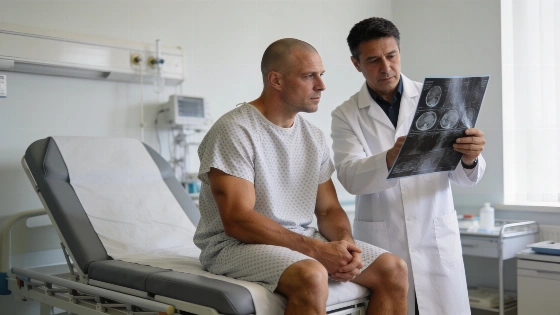
Four months after getting an experimental CAR T cell therapy, Ross Matthews waits for scan results that could change everything. He was diagnosed at 38 with stage 4 BRAF-mutated colorectal cancer. This type is known for being aggressive and hard to treat. Matthews has already lived longer than most with this diagnosis. Now, he is one of the first to try a new kind of treatment that could help people who have run out of options.
The FDA granted traditional approval to encorafenib for metastatic colorectal cancer with a BRAF V600E mutation in February 2026, reflecting rapid changes in treatment standards for this aggressive subtype.
Matthews has had two HIPEC surgeries and is still on palliative chemotherapy. These treatments have kept him active enough to run ultramarathons, but they have not cured him. The BRAF mutation, found in about 10% of colorectal cancer cases, makes the disease move fast. Matthews learned early that his five-year survival odds were less than 20%.
For people like Matthews, current treatments fall short. Immunotherapies have changed the outlook for some cancers, but in colorectal cancer, only about 4% of patients qualify for approved immunotherapy based on a certain biomarker. Matthews does not have this marker. Last May, Lieu told him about a nationwide clinical trial testing a new target—guanylyl cyclase C (GCC)—using CAR T cell therapy. CU Anschutz is one of only four sites in the U.S. running this trial. The drug company is paying for Matthews’ treatment.
Recent expert reviews highlight that earlier CAR-T studies targeting CEA in colorectal cancer showed some tumor responses but were limited by inflammatory colitis, as CEA is also present in normal intestinal tissue. This safety challenge has driven the search for new, more selective targets like GCC, B7-H3, and IL-8 in current and upcoming trials.
At the same time, CU Anschutz researchers, including Lieu, have received FDA clearance for a new clinical trial using a homegrown CAR T cell therapy. This next step will target two proteins—B7-H3 and IL-8—found on most colorectal tumors and linked to tumor growth and spread. The trial is set to start in December. The Gates Biomanufacturing Facility will make the experimental cells, and the project is backed by donations. According to BioWorld, the FDA clearance covers both adults with advanced colorectal cancer and children with solid tumors who have no standard options left. This shows how urgent and wide-reaching the research is.
Matthews’ story shows how unpredictable cancer can be. When he started treatment, his daughter was starting kindergarten and his son was just three months old. Now, years later, he is still active and with his family. He refuses to let statistics decide his future. “Statistics can give us valuable general information, but they don’t necessarily predict what your future will look like,” Lieu says.
As Matthews waits for his latest scan results, he knows what he wants. “I’d love for a miracle to be part of my story. But honestly, I’d be thrilled with no progression. If I could do CAR T therapy once, have no progression, and stay on chemotherapy for a couple of years, that would be awesome.”
This story is not just about one patient’s resilience. It is also about CU Anschutz scientists and doctors pushing hard for real change. Lieu is clear: “We’re not aiming for an incremental advance. We’re aiming for a paradigm-shifting one. We’re aiming for a cure.” The launch of a new, locally developed CAR T cell trial shows a real push to break old limits and try therapies that could change the outlook for people with treatment-resistant colorectal cancer. The future is still uncertain. But for patients like Matthews, the drive to change the story means everything.