
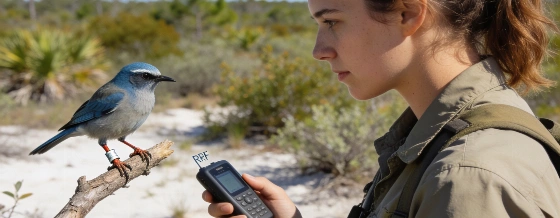
In a large-scale experiment, forty-eight Florida scrub-jays hatched in 2025 were moved together to a new site as part of a genetic rescue effort. Within six months, four out of ten pairs of these one-year-old birds attempted to nest—a dramatic jump from the 0.25% early breeding rate seen in past monitored populations. This surge is the first clear sign that moving many birds at once could change the outlook for one of Florida’s most threatened species.
The Florida scrub-jay was federally listed as a threatened species in 1987, and its population was estimated at just 4,000 breeding pairs in 1993.
This project takes a different approach from earlier efforts. Instead of moving a few birds at a time, the team filled the new site to its estimated carrying capacity in one move. All the birds were the same age, which helped avoid the usual dominance struggles that can slow down integration. Rather than settling into helper roles, most of the translocated jays immediately looked for their own breeding territories. This shift could speed up genetic mixing and population growth.
The 2026 translocation was a collaborative effort involving UCF, Archbold Biological Station, the U.S. Fish and Wildlife Service, Verdantas, and the Mosaic Company. UCF describes it as the first large-scale initiative of its kind for genetic rescue in Florida scrub-jays.
This experiment builds on nearly twenty years of regional recovery work, including early mitigation led by the Mosaic Company and the late Reed Bowman. Today, Raoul Boughton of Mosaic and Sahas Barve of Archbold Biological Station join Deaner as co-principal investigators, bringing together expertise in ecology, avian biology, and conservation genomics.
Deaner’s path to this project began with years of fieldwork on Florida scrub-jays. Collecting data during earlier translocations—and realizing that key answers were buried in those records—pushed her toward advanced research. Now, in Eric Hoffman’s Conservation Genomics Lab at UCF, she draws on both field experience and molecular tools to tackle the species’ recovery from multiple angles.
According to a WUSF environment report, all 48 birds survived the January 2026 move to Wingate Creek State Park in Manatee County, and nesting attempts were seen in the first season. The birds were chosen to match the site’s carrying capacity, and all were the same age to reduce competition.
It is still early, but these first nesting attempts offer a rare look at how genetic integration might play out. The team will keep monitoring whether the translocated birds pass their genetic diversity into the local population—a process that could shape the species’ long-term future.
Deaner will present preliminary results at the International Conservation Translocation Conference in Edinburgh, Scotland this September. She sums up her approach: “It's not the taxa that's important, it's the questions. As long as the questions are the ones that trigger your curiosity, you are heading in the right direction.”
This project shows how conservation genomics, careful fieldwork, and new population management strategies can work together to produce real results. If these early trends continue, Deaner’s work could change how endangered species are rescued wherever genetic bottlenecks threaten biodiversity.