
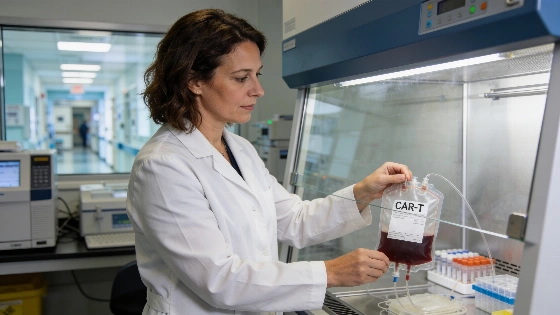
First patients have now received LNK001 at MD Anderson Cancer Center. This is Link Cell Therapies' logic-gated CAR-T, built for people with advanced or metastatic clear cell renal cell carcinoma. The company is betting big. It has raised $90 million in Series A funding and brought in a new executive team with deep biotech experience.
CTMC, the manufacturing partner for LNK001, is a joint venture between Resilience and The University of Texas MD Anderson Cancer Center, and has been positioned as a dedicated cell therapy manufacturing platform.
CTMC, a joint venture of Resilience and MD Anderson, handles manufacturing for LNK001. The trial is listed at clinicaltrials.gov as NCT07564232. Link is already planning a second solid tumor trial. Colorectal cancer is next, with a new target pair set for the clinic in 2027.
The company is not standing still. Leadership has changed. Jie D'Elia, Ph.D., is now CEO. She led SystImmune and held senior roles at Bristol Myers Squibb, Simcere Pharmaceutical, AstraZeneca, and Boston Consulting Group. Her deals top $40 billion. She is known for building oncology and cell therapy pipelines. Brian Slingerland, Link's co-founder, moves to Executive Chair. He previously led Stemcentrx, which Abbvie bought for $6.2 billion. Friedrich Graf Finckenstein, M.D., joins as Chief Medical Officer. He comes from Iovance Biotherapeutics, where he helped win the first cell therapy approval for a solid tumor, and from Roche Pharma Research and Early Development.
According to an industry funding analysis, Link Cell Therapies was previously listed with a Series A round of $60 million as of December 2025, suggesting the recent $90 million figure may reflect a subsequent upsize that requires confirmation from a primary source.
Link's Series A started at $60 million, led by Johnson & Johnson Innovation – JJDC, Inc. Now it stands at $90 million. Founding investors Samsara BioCapital and Sheatree Capital are joined by Wing Venture Capital and new backers: BMS, Kyowa Kirin, Sherpa Healthcare Partners, Western Technology Investment, and the MD Anderson Cancer Focus Fund. The new funds will push both clinical and preclinical logic-gated CAR-T programs forward. Link is also working on new assets for solid and blood cancers.
The logic-gate platform is built to make CAR-T work in solid tumors. This has been a tough problem for years. Dr. D'Elia put it simply: "A targeting approach that reliably distinguishes tumor from healthy tissue is what allows CAR-T to pursue in solid tumors the kind of deep and durable responses it has achieved in hematologic cancers."
Other groups are also moving fast. As reported earlier, experimental CAR-Ts are being tested in colorectal cancer. The race is on.
Link Cell Therapies was founded in 2022 by Robbie Majzner, M.D., Crystal Mackall, M.D., Brian Slingerland, and Samsara BioCapital. The company is based in South San Francisco. Its logic-gating tech is designed to find "clean" target pairs—antigen combos found on cancer cells but not on healthy tissue. The aim is safer, next-generation CAR-Ts for both solid and blood cancers.
Link now has a strong leadership team, new funding, and a clinical program in motion. The company is taking on the hardest problems in solid tumor targeting. It has both scientific and financial backing. This could be a turning point. If Link's dual-antigen CAR-T works in the clinic, it could change what is possible for cell therapies in solid tumors.