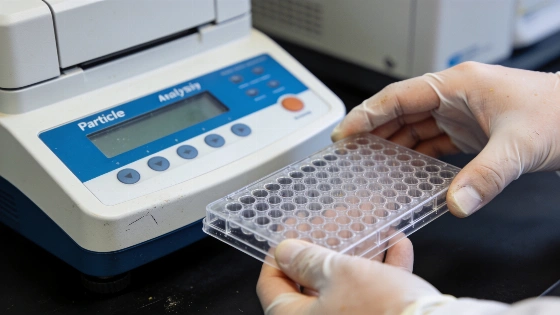
Zetasizer Core is the immediate product link between Malvern Panalytical and Dimer Instruments. The high-throughput system combines three measurement techniques in a standard microwell plate workflow.
Zetasizer Core can process up to 192 samples in one run at a temperature ramp of 1°C per minute. The stated analysis time for antibody stability is less than 1.5 hours.
The companies say Dimer’s research and development capabilities, paired with Malvern Panalytical’s scientific expertise, will support further analytical tools for drug development. Malvern Panalytical also brings its product portfolio and international customer network.
Three measurements in one workflow
Dynamic light scattering, or DLS, measures particle size in suspension and helps researchers assess protein size and aggregation. Static light scattering, or SLS, provides information about protein-protein interactions and colloidal stability. Differential scanning fluorimetry, or DSF, tracks changes associated with protein unfolding as temperature rises.
Each technique has a separate detector. The optical head combines a laser with a DLS collector. A linear photodiode handles SLS, while a UV LED and DSF fluorescence collector support the third measurement. BioSpace’s technical account says this setup enables simultaneous measurements while reducing the risk of cross-talk.
Those readings are intended to help scientists examine the physical and structural stability of biotherapeutic candidates. The platform supports standard 96-, 384- and 1536-well plates, making it compatible with laboratory automation systems. Malvern Panalytical says the combined workflow lets researchers screen more samples, compare candidates and assess formulations with less manual handling.
The manufacturer also describes an automated five-step setup. Its product materials cite “gold standard” algorithms and data processing designed to account for temperature lag, as outlined in News-Medical’s description.
Malvern Panalytical’s broader biopharma toolkit also includes ITC and GCI. These techniques assess binding affinity, thermodynamics and kinetics, complementing Zetasizer Core’s focus on hydrodynamic size, aggregation, and colloidal and thermal stability.
The development-stage case is straightforward: identify potential stability problems before expensive downstream work. The announcement describes applications in biologics discovery and formulation development, as well as quality control. It provides no performance comparisons and no evidence that the system has already improved development outcomes.
A collaboration becomes an acquisition
The purchase follows Malvern Panalytical’s minority investment in Dimer in April 2024. The companies had already established a collaboration. Dimer is headquartered in Santa Barbara, California, and was founded by biophysical characterisation and analytical instrumentation specialists Dr Stephen Minne and Dr Michael Larkin.
This is a research-tools deal, not a drug-asset transaction. It is distinct from the manufacturing footprint expansion covered in Ofichem’s US expansion. Malvern Panalytical President Christian Sauber said bringing the teams together would build on Zetasizer Core and support further technologies. Dimer CEO Stephen Minne said joining Malvern Panalytical would help accelerate innovation and bring new analytical tools to laboratories worldwide.
Malvern Panalytical’s history in particle sizing and biophysical characterisation dates to the late 1960s. The company formed in 2017 through the merger of Malvern Instruments and PANalytical. The combination brought together materials characterisation expertise with X-ray analytical technologies.
The companies had an existing collaboration, and Zetasizer Core targets a defined screening workflow. The available reporting does not establish the deal value or legal closing date. It also provides no regulatory decisions and no published comparative evidence of improved drug-development outcomes.