
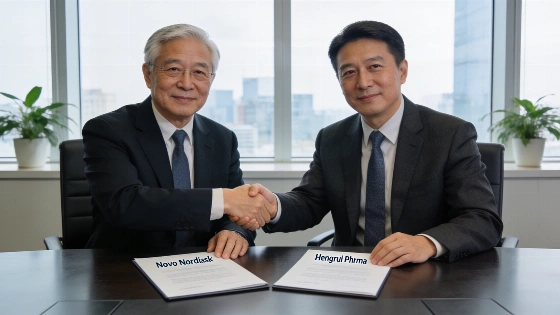
Novo Nordisk has clinched exclusive global rights to Hengrui Pharma’s HRS-1596, a dual GLP-1/GIP receptor agonist. The deal covers all markets except mainland China, Hong Kong SAR, Macao SAR, and Taiwan Region. HRS-1596 is set for phase I trials and is designed for once-weekly oral dosing. The agreement is worth up to $2.6 billion. Hengrui Pharma gets $300 million upfront. More milestone payments could follow, tied to development, regulatory, and commercial goals. These details come from a Reuters financial review.
Chinese regulators have already granted approval for Hengrui Pharma to begin phase I clinical trials of HRS-1596, positioning the drug as phase I-ready for weight management and type 2 diabetes.
Novo Nordisk will handle development, manufacturing, and sales of HRS-1596 worldwide, except in the Chinese mainland, Hong Kong SAR, Macao SAR, and Taiwan Region. Hengrui Pharma keeps rights in those areas. The company will also get royalties from net sales in Novo Nordisk’s licensed territories, on top of the upfront and milestone payments.
Frank Jiang, MD, PhD, Executive Vice President and Chief Strategy Officer at Hengrui Pharma, said, “We are committed to continuous innovation, bringing better treatments to patients. HRS-1596 reflects this commitment in metabolic diseases, with the potential to offer the convenience of once-weekly oral administration.” Martin Holst Lange, MD, PhD, Executive Vice President, Research & Development and Chief Scientific Officer at Novo Nordisk, said, “Hengrui Pharma has a proven track record of discovering and advancing innovative therapies with the patients in the center, and we are excited to add HRS-1596 to our growing pipeline and to explore its potential to raise the bar for convenience in the field.”
Hengrui Pharma is currently the largest pharmaceutical company in China by market capitalization, and this licensing deal grants Novo Nordisk the rights to develop, manufacture, and commercialize HRS-1596 outside the specified Asian markets.
This deal shows Novo Nordisk’s push to grow its oral peptide pipeline and keep its lead in metabolic disease. Hengrui Pharma is using its innovation to reach new markets. The focus on once-weekly oral dosing highlights the race to make obesity and diabetes treatments easier for patients. All eyes are now on HRS-1596. The stakes are high.