
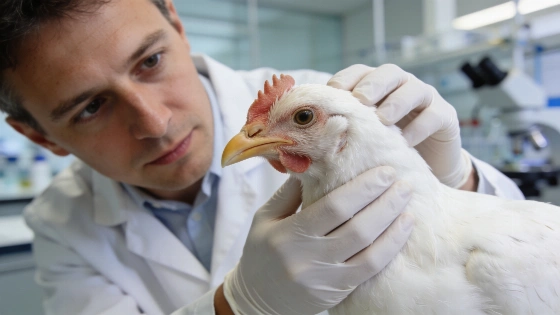
Lab chickens with built-in resistance to bird flu are no longer just theory. At The Roslin Institute, researchers are now editing chicken DNA to fight the spread of avian influenza in poultry flocks worldwide.
Professor Mike McGrew has spent more than 20 years working on ways to help the poultry industry. He leads the avian reproductive technologies group at The Roslin Institute. His team is focused on one question. Can gene editing make chickens less likely to catch deadly avian influenza?
As of October 2026, the USDA Agricultural Research Service has catalogued 376 scientific publications on avian influenza in poultry, reflecting the ongoing intensity of research into vaccines, genetics, and disease control.
How the virus is blocked
McGrew’s group took a direct route. They edited a small piece of chicken DNA that the flu virus uses to infect cells. The result: birds that were harder to infect. The change did not make chickens fully immune. But it did make it tougher for the virus to take hold. McGrew explained, “We used gene editing to alter a small section of bird DNA and this was able to restrict, although not completely block, the flu virus from infecting chickens.”
The Data-Driven Innovation (DDI) initiative published an official case study in September 2026. It shows the Roslin Engineering Biology Hub is using genetic selection and genome editing to breed healthier livestock. Avian flu-resistant chickens are a key result. The DDI report confirms this is not a one-off. The work is part of a larger research program tied to The Roslin Institute’s advanced engineering biology labs. These projects aim to bring genetic breakthroughs into real-world livestock health. The goal is to fight urgent disease threats and build long-term sustainability.
A recent review by the USDA Agricultural Research Service highlights that avian influenza vaccines in poultry can prevent clinical signs and mortality, increase resistance to infection, and reduce virus shedding into the environment. This underscores why genetic resistance is being explored as a complementary, rather than sole, tool for disease control.
Beyond rare breeds
The impact goes further than just disease resistance. McGrew’s lab also built surrogate host technology to create gene-edited chickens. At first, this was for saving rare poultry breeds. Now, the same tools can help spread disease-resistant traits into many chicken lines. The team’s long-term vision even includes other bird species at risk of extinction. For now, stopping avian influenza is the main target.
For McGrew, making progress on flu-resistant chickens is a career milestone. The work shows how gene editing and reproductive biology can work together. It’s about tackling urgent industry threats and helping conservation at the same time.
Avian influenza keeps hitting the poultry sector. The Roslin Institute’s research points to a new approach. Genetic innovation is joining traditional disease control. The facts are clear. Full resistance is not here yet. But gene editing is already making a difference. The next big step in flock health may come from the lab, not just the vaccine bottle.