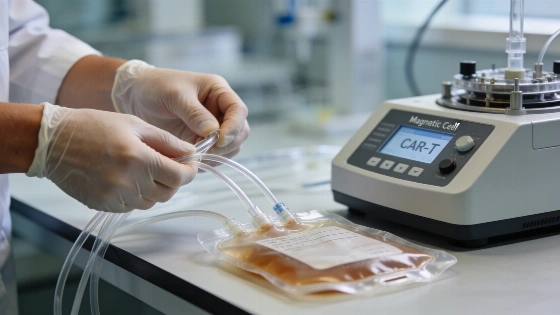
In an approved CAR-T workflow, clinicians collect a patient’s own T cells. The cells are modified to introduce the CAR gene, then expanded before they return to the patient.
The global market index for GMP cell-selection reagents is forecast to reach 285 by 2035, with 2025 set at 100. Reagents used to isolate target cells are moving into regulated production processes, beyond their traditional role as research supplies. A separate industry forecast distributed by GlobeNewswire puts the broader cell and gene therapy market at $21.43 billion in 2025 and projects $172.22 billion by 2035. Cell-therapy manufacturing accounted for more than 59% of historical revenue in that broader market. Those figures are not estimates for selection reagents.
Demand tracks the expansion of CAR-T and other advanced therapies. GMP-grade starting materials face regulatory requirements, while manufacturers are using more closed automated systems. The report expects Asia-Pacific to grow fastest. North America remains the largest market.
An industry forecast puts the global cell and gene therapy market at $21.43 billion in 2025 and projects $172.22 billion by 2035. Cell-therapy manufacturing represented more than 59% of historical revenue in that broader market; the figures are not estimates for cell-selection reagents.
Manufacturing qualification shapes demand
CAR-T manufacturing accounts for an estimated 45% of demand, the largest end-use segment. Other cell therapies, including TCR-T, account for an estimated 25%. NK therapies and tumor-infiltrating lymphocyte therapies are included in that segment. Process development and clinical trial material production account for 15%. Academic and research applications account for 10%, while other uses such as diagnostics and veterinary applications make up 5%. These segment shares are estimates attributed to the report and are not independently confirmed by the available research context.
Manufacturers can adopt GMP reagents during process development to avoid changing materials later in the clinical pipeline. Once a reagent appears in a regulatory filing or is qualified for a commercial process, switching can require re-validation. That gives established suppliers and products used in pivotal trials a hard-to-shift position. Supply can also be constrained by bottlenecks in GMP-grade antibody production and consistent magnetic-particle synthesis.
More broadly, cell-therapy manufacturing faces shortages of GMP production slots. Trained personnel are also in short supply. Viral vectors and critical raw materials face shortages, while autologous products bring custody and logistics challenges.
The report identifies MACS and closed automated platforms as technologies used in selection workflows. Its account of antibody and magnetic-particle supply constraints echoes issues examined in an earlier supply analysis, though the products and bottlenecks differ. Quality programs track viability and purity through selection. Identity and potency are assessed as cells move through modification and expansion. Sterility is also tracked through infusion; sensitivity to process variation makes batch-level and timely testing important. A nonviral CAR delivery report describes laboratory-stage findings. Scalable GMP processes for these newer platforms have not been confirmed.
The Asia-Pacific next-generation centrifuge market is forecast to grow at a CAGR of 8.95% through 2031, reflecting expansion of biopharmaceutical capacity in China, South Korea, Japan and India. This is an adjacent equipment-market indicator, not a forecast for cell-selection reagents.
Regional leadership and forecast caveats
North America represents an estimated 35% of the market, supported by its concentration of biopharma companies. CDMOs and academic research centers also support the region’s position. Asia-Pacific holds an estimated 30% and is forecast to grow fastest as clinical-trial activity and manufacturing capacity expand. Europe accounts for 20%. Latin America accounts for 8%, while the Middle East and Africa hold 7%. A Japanese market review summarized by Yahoo Finance says pre-commercial and R&D activity represents nearly 70% of that country’s current cell and gene therapy manufacturing market. Commercial production is expected to be its fastest-growing segment.
The forecast contains an inconsistency. Its abstract gives a 12.4% CAGR for 2026–2035, while the Market Outlook section states 12.0%. Both sections project an index of approximately 285 by 2035. The report uses indexed curves because full absolute market volumes are not publicly disclosed. Available research does not substantiate official FDA statements specifically about the GMP cell-selection reagent market. The same gap applies to the EMA and other regulators.
Thermo Fisher Scientific and Miltenyi Biotec are among the suppliers identified in the report. Cytiva and STEMCELL Technologies also appear, as does Bio-Techne. The competitive field includes specialized manufacturers alongside broader bioprocessing companies.
Demand growth depends on more than pipeline expansion. Commercialization of allogeneic therapies remains uncertain. Reimbursement and access also remain open questions. Supplier concentration and raw-material disruptions are additional risks. Supplier capacity and the pace at which cell therapies reach commercial production will determine whether projected demand becomes durable business.