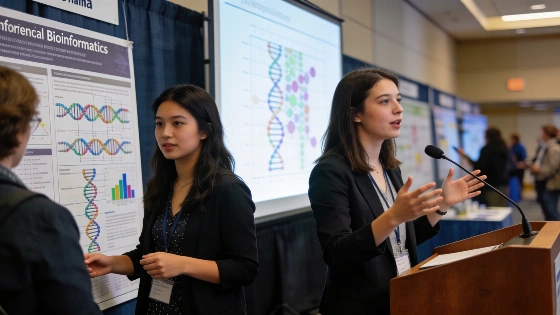
September 28, 2026. Omaha’s Great Plains Bioinformatics conference opened its doors to new ideas in computational biology. Two students from Dr. Wheeler's Lab at Loyola stepped up with research that pushes the limits of machine learning and deep learning in genomics.
Tooba Rizwan, a senior in Bioinformatics, took the stage for an oral presentation. Her talk: “Integrating Deep Learning Regulatory Features with Single-cell Transcriptomes Identifies Cell-Type Specific Genes Associated with Skin Cancer.” Rizwan’s project dives into deep learning and single-cell transcriptomics. She aims to find genes tied to skin cancer, but not just any genes—those linked to specific cell types. Her method uses advanced computational models to pull out regulatory features from transcriptomic data. This gives a sharper look at how gene expression works in cancer.
In 2026, the World Health Organization updated its malaria guidelines to include new recommendations for single-dose primaquine therapy and pediatric artemether-lumefantrine formulations for children under 5 kg.
Belinda Ofosu, an MS Bioinformatics student, presented a poster on her thesis: “Machine Learning for Antimalarial Resistance Prediction from _Plasmodium falciparum_ Whole Genome Sequence Data.” Ofosu’s work uses machine learning on whole genome sequencing data from _Plasmodium falciparum_, the parasite behind malaria. Her goal is to predict resistance to antimalarial drugs. This could help spot resistance patterns sooner. It might shape public health plans and treatment choices. A summary of the 2026 WHO malaria guidelines points out that new updates now stress the need for genomic surveillance and new therapies to fight rising resistance.
Computational methods drive genomic discovery
These projects show how much computational methods matter in genomics now. Rizwan’s deep learning approach with single-cell transcriptomics tackles the tough job of finding disease genes in mixed cell groups. Ofosu’s machine learning work on antimalarial resistance shows how algorithms can turn raw genomic data into real answers for infectious disease control. In 2026, reports noted genetic changes in _P. falciparum_. Partial resistance to artemisinin drugs and loss of HRP2/HRP3 proteins have made diagnosis and treatment harder. The need for better computational tools is clear.
Academic impact and future directions
These students didn’t just attend a conference. They brought Loyola’s research to a major event run by the International Society for Computational Biology. Their work shows the technical strength of Dr. Wheeler's Lab. It also proves how important it is to train students at the crossroads of biology, computation, and data science. Machine learning and deep learning are moving fast. The next wave of bioinformaticians is ready to push disease research and therapy even further.
The World Health Organization has emphasized that artemisinin-based combination therapies may remain effective if the partner drug retains efficacy, even in the presence of partial artemisinin resistance. Reports of partial resistance do not equate to confirmed treatment failure.