
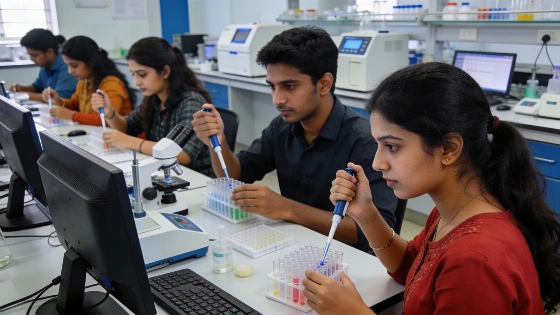
Rows of students filed into Madurai Kamaraj University’s labs this year, trading textbooks for pipettes and code. The university rolled out a large-scale skills push, putting 7,200 students through 100 short-term courses aimed at closing the stubborn divide between academic theory and what employers actually want. The National Higher Education Mission of the Union Ministry of Education backed the program, which tackles the employability crunch in research and tech fields head-on.
MKU’s approach covers more ground than most. Courses ran from three to ten days, with faculty leading hands-on sessions in genomics, bioinformatics, artificial intelligence, molecular diagnostics, renewable energy, and business administration. The curriculum stretched into cell culture, drug screening, chemistry instrumentation, electrochemistry, cloud computing, cybersecurity, media production, design, communication, food entrepreneurship, and agriculture. The university’s message: students need job-ready skills that standard syllabi skip.
According to independent educational directories, Madurai Kamaraj University offers a wide range of full-time diploma, master's, and doctoral programs, but there is no verified data on employment outcomes for participants of its short-term skill courses.
Infrastructure and Faculty Drive the Program
The university leaned on its research infrastructure, built up with help from the Rashtriya Uchchatar Shiksha Abhiyan (RUSA). RUSA Coordinator Prof Kumaresan pointed to specialized labs and equipment worth about Rs 20 crore: an Ancient DNA Laboratory, a Biosafety Level III (BSL-III) lab, high-content drug screening platforms, and a skill development lab with 300 computers and a high-performance computing setup. Faculty with active research and international publications ran the training, grounding sessions in current science rather than theory alone.
RUSA is known for funding upgrades at public universities across India, but no independent document confirms the ₹20 crore allocation to MKU for these labs and equipment. Still, third-party educational listings back up the presence of advanced research facilities at MKU, especially in science and technology.
MKU is now reviewing course outcomes to spot strengths and gaps. The administration wants to turn this into a continuous skill development center and expand how students can access these programs.
Despite the scale of the recent skills initiative, there are no official statements from the Ministry of Education of India, RUSA, or regulatory bodies confirming the effectiveness of the program, employment rates of participants, or plans to convert it into a permanent skill development center.
Broader Context and Editorial Perspective
This wave of practical training at MKU comes as India’s higher education sector faces pressure to produce graduates who can keep pace with fast-changing science and tech. The university’s model, built on research infrastructure and faculty expertise, gives other institutions a working example for bridging the academic-industry gap. The focus on genomics, bioinformatics, and digital tech lines up with priorities seen in recent scientific awards, including those covered in the Blavatnik Awards for gene editing and bioelectronics breakthroughs.
Educational program listings show MKU continues to offer a wide range of accredited degrees in science, technology, and management. Independent reviews, though, do not provide verified statistics on employment outcomes or the long-term impact of these short-term courses. The university is waiting to see if its model gains traction elsewhere or if industry starts to value these new credentials.