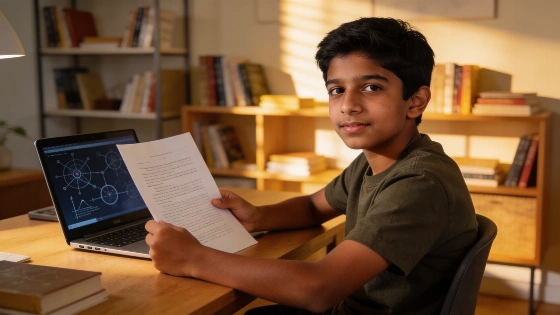
On July 4, 1776, a Philadelphia print shop buzzes with work. In Aryash Shyam’s story, a 13-year-old apprentice named Will sets type for the Declaration of Independence. The words promise equality. The reality is different. Shyam, a ninth grader from Pennsylvania, turned this moment into 'The Weight of Lead.' His story just won him a $1,000 prize and publication as one of four middle-school winners in the 2026 John Estey Student Writing Competition, run by the American Writers Museum in Chicago.
Shyam doesn’t dodge the hard truth. The story puts the famous phrase 'all men are created equal' next to the fact that freedom was not for everyone. Will, the apprentice, sees this gap up close. He notices another boy whose future looks nothing like his own. The story makes the contradiction impossible to ignore.
The John Estey Student Writing Competition is officially part of the American Writers Museum’s annual programming, with a dedicated celebration of winners held during the OnWord 2026 event in Chicago.
From CRISPR in space to the printing press of 1776
Shyam’s interests stretch far beyond fiction. At Lehigh Valley Academy, he stands out in space biology, gene editing, robotics, and science communication. Earlier in 2026, he won the Genes in Space Junior Scientist Award. His project? A plan to test a compact CRISPR-based diagnostic in microgravity. Only five projects were picked from 130 national entries. Shyam’s idea: see if a freeze-dried CRISPR-Cas13 system can be activated with water and used to spot target RNA in space. The stakes are high. Astronaut health and remote diagnostics on Earth could both benefit.
The John Estey Student Writing Competition is not just a school contest. The American Writers Museum’s official calendar shows it is part of the museum’s annual benefit programming. Winners will be celebrated on September 29, 2026, in Chicago. The award is national. The prestige is real. Details are listed in the museum’s OnWord 2026 event listing.
Shyam also knows how to make science clear. He took first place in the high-school category of the 2026 American National Standards Institute Student Paper Competition. His essay explained ISO 80369, a standard that stops dangerous medical tubing mix-ups. He wrote from experience as a surgical patient. The message was simple: design standards can save lives by making it impossible to connect the wrong tubes. Shyam’s essays in economics, philosophy, and science and technology all made the shortlist for the 2026 John Locke Institute Global Essay Prize.
The American Writers Museum’s event page highlights that the John Estey Student Writing Competition is recognized as a national student writing award, with the 2026 winners celebrated as part of the museum’s official programming.
Innovation beyond the page
Shyam doesn’t stop at writing or research. He built GreenBeam, a robotic system that uses AI and a laser to spot and destroy invasive weeds. No chemicals needed. He coded it in Python and trained it on plant images. The project earned him Pennsylvania State Merit in the 2025 3M Young Scientist Challenge. Why did he build it? Shyam said, 'I kept coming back to a problem that seemed solvable.' He wanted to protect native plants and soil from invasive species—without harm.
He’s also a communicator. Shyam hosts Teen Scientist on WDIY 88.1 FM, Lehigh Valley Public Radio. He interviews researchers and innovators about AI, biotech, and climate solutions. He remembers his first live show: 'A real scientist across the table, a page of questions I had carefully prepared, and thirty minutes to make the conversation count.' He has produced a documentary, Editing Humanity: A CRISPR Conundrum. He founded RacingGecko, a STEM-learning platform for younger students.
What ties it all together? Curiosity. Shyam wants to know how things work and how ideas can fix problems. He builds robots, questions gene editing, and writes about the contradictions of American independence. For him, science, technology, and literature are not separate worlds. His latest award brings him back to the written word. The question remains: what does equality mean, when history is set in lead, one letter at a time?