
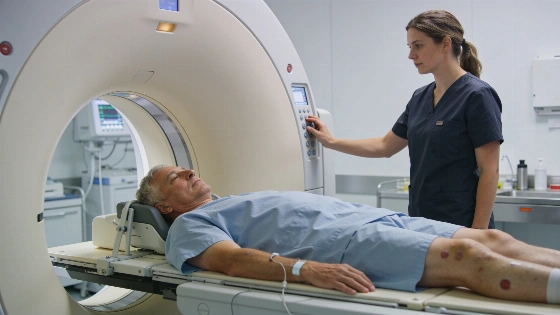
Doctors at seven centers tried something different for people with multiple myeloma and painful bone lesions. They used ultralow-dose radiation—either a single 4-Gy dose or two 2-Gy sessions. The results surprised many. Pain dropped sharply. Side effects stayed low. Bone marrow stayed healthy. These findings come from a prospective phase II trial led by Leslie Ballas, MD, at Cedars-Sinai Medical Center. The study enrolled 69 patients with painful but uncomplicated bone lesions. Anyone with prior radiation, surgery, or complex bone problems was excluded. Details appear in a Medscape clinical report.
Six months after treatment, 86% of patients who could be evaluated had either full or partial pain relief. That number was higher than the 66% response at 4 weeks and 64% at 8 weeks. These results came with radiation doses much lower than the usual 30-Gy standard. The old thinking about how much radiation is needed for myeloma bone pain may not hold up. Only 19% of patients needed another round of radiation. The protocol allowed repeat treatments without building up marrow toxicity.
The study found that most adverse events were mild, with no cases requiring treatment interruption or modification, and side effects rarely exceeded grade 2 severity.
Bone marrow stays protected
The trial showed that bone marrow can be spared. Ballas said the ultralow-dose approach lets patients keep their blood counts stable. They can stay on chemotherapy. They remain eligible for future treatments like transplant or CAR T-cell therapy. Serious side effects were rare. No patient had to stop or change treatment because of toxicity. Most side effects were mild fatigue or skin changes, as Rare Cancer News reported.
Getting into the trial was not easy. Patients needed a Brief Pain Inventory score of 2 or higher. They could not have had prior radiation, surgery, broken long bones, spinal cord compression, or skull base/orbital lesions. The main goal was to measure pain response and daily oral morphine use at 4 weeks. The team used strict definitions for what counted as a full or partial response.
How this fits with past evidence
Most earlier studies on palliative radiation for myeloma were retrospective. Only one prior prospective trial compared 30 Gy to 8 Gy. That older study found about 80% of patients got pain relief. The new trial suggests even lower doses can work just as well—or better. The idea to test 4 Gy in two sessions came from indolent lymphoma, which is also sensitive to radiation. In lymphoma, similar doses have brought 80–90% pain relief.
According to Myeloma UK, radiotherapy for myeloma bone disease is used selectively, mainly for spinal cord compression, severe refractory pain, or to prevent/treat pathological fractures, as it may impair local bone healing.
ASTRO expert Chelsea Pinnix, MD, from the University of Texas MD Anderson Cancer Center, called the study "exciting." She said the results could change how doctors treat myeloma bone pain. "The findings suggest that many patients can experience meaningful pain relief with a very low initial radiation dose," Pinnix said. The treatment is quick and easy for patients. Side effects are few. This could lead doctors to use radiation earlier for bone pain in myeloma.
Myeloma care is changing. People are living longer and getting more lines of therapy. Protecting bone marrow matters more than ever. Ballas pointed out that exposing more marrow to 10 Gy or higher increases the risk of blood problems. Lowering the dose helps. The trial's design fits this need. It offers a way to balance pain relief with safety.
How long does relief last?
Of the 69 patients, 12 needed another round of radiation. Doses ranged from 8 to 24 Gy, with a median of 20 Gy. The median time before needing more radiation was 61 days. Even after re-irradiation, 69% still got pain relief. Both the single and two-fraction groups had similar response rates at all time points. But the two-fraction group saw a bigger drop in pain score at 6 months (4.1 vs 2.2, P=0.01).
The results match the move toward more tailored, risk-based radiation in blood cancers. The prospective design and strong comparison to past data make the findings credible. Ballas said more trials may not be needed before using this approach in practice, as long as patients know there is a small chance they may need more radiation later.
For those tracking new ways to protect bone marrow, this study adds to earlier reports on shielding healthy blood during tough cancer treatments.
The takeaway is simple. Ultralow-dose radiation is not just a technical tweak. It brings real, lasting relief for myeloma bone pain. Side effects are few. Bone marrow stays safe. Patients keep their options open for future therapy. This approach is ready for real-world use.