Fewer than one in 20 genomes in a new global atlas of freshwater microeukaryotes could be assigned to a known genus. Researchers also found about 750 species with no match in any known group. The study expands the genomic reference collection; it does not mean those organisms newly appeared.
The team reconstructed nearly 20,000 mitochondrial genomes, representing around 3,660 species, from 3,400 existing environmental DNA datasets. The samples came from 362 lakes and reservoirs across 28 countries on every continent. For several groups of algae and related organisms, the atlas contains between six and more than 20 times as many species as the leading reference genomic database. An international team that included scientists at the University of Zurich led the research. The university calls it the first global mitochondrial genomic atlas of freshwater microeukaryotes, while describing the resource as a growing reference rather than a complete inventory.
Reading a lake sample through its DNA
The method mines existing metagenomic datasets, which were not originally collected to reconstruct mitochondrial genomes. Researchers sequence DNA from environmental samples, then use a machine-learning tool to identify mitochondrial sequences and assemble genomes from the metagenome. That can capture organisms beyond those chosen in advance for targeted tests. Mitochondria have relatively small genomes, making them easier to reconstruct. Their faster evolutionary change can also help distinguish closely related species.
To compare samples consistently, the team treated mitochondrial genomes at least 98.1 percent identical as belonging to the same species. That is an empirical working threshold, not a universal biological rule for all microeukaryotes. As researchers add to the atlas, they can compare new samples against a broader reference collection. Further morphological and phylogenetic study may refine species boundaries and individual groupings.
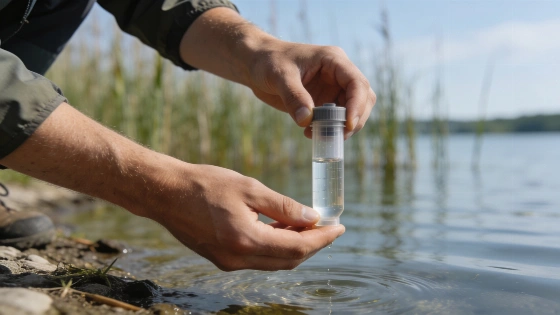
A single bottle of water could eventually speed up lake monitoring.
Researchers may be able to track shifts in microeukaryote communities by comparing new sample DNA with the reference genomes. They could then investigate conditions such as warming or pollution. The study presents this as a potential application, not as a proven early-warning system. Putting it into practice would require regular sampling and standardized protocols. It would also take quality control and independent assessment of how genetic signals relate to ecological risks. The atlas would complement ecological and toxicological monitoring. It would not replace tests of whether detected organisms are viable.
Why microscopic identification matters
Microeukaryotes include microscopic algae and single-celled organisms such as amoebae. They convert sunlight into organic matter, contributing to primary production. They also consume bacteria, while larger organisms in lake food webs feed on them. Routine monitoring has long relied on counting organisms under a microscope, using a method developed in 1958. That work is slow and depends on specialist expertise that is becoming scarce.
Microscopy can miss consequential differences. A harmless alga may look identical to a toxic relative. In 2022, a toxic microalgal bloom in the Oder River on the German-Polish border killed around 360 tonnes of fish.
Researchers have seen only a fraction of the life in lakes and reservoirs for more than 60 years, says Adrian-Stefan Andrei, head of the Microbial Evogenomics group at the University of Zurich’s Limnological Station. Those waters provide drinking water to more than 180 million Europeans. Lead author Lucas Serra Moncadas says much of the biodiversity supporting lake ecosystems remains undocumented. The atlas aims to close part of that reference gap, letting researchers detect organisms from DNA even when appearance alone cannot identify them confidently, according to the University of Zurich.
The findings were published on 25 September 2026 in Nature Communications under the title “A global mitochondrial genomic atlas illuminates freshwater microeukaryote diversity,” DOI: 10.1038/s41467-026-78160-1.