
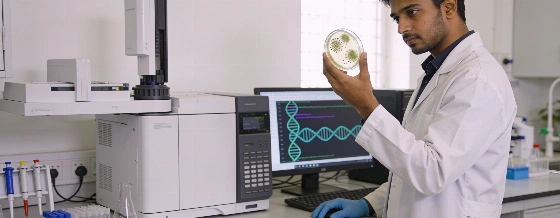
Artificial intelligence has moved from theory to practice in biotechnology: researchers at Stanford University and the Arc Institute have used AI to design entirely new viruses—bacteriophages—that infect and kill bacteria. For the first time, AI models generated hundreds of viral genomes, and sixteen of these produced working bacteriophages that destroyed Escherichia coli in lab tests. These are not just digital models; they are living organisms, built and tested in the real world.
The Evo 2 model was trained on 9.3 trillion nucleotides from over 128,000 complete genomes and metagenomic datasets, making it one of the largest biological AI models ever used for generative sequence design.
This is more than a technical achievement. It marks a shift in how biology is done. Instead of just reading and editing DNA, scientists can now design it. AI systems treat DNA like a language, learning its patterns to predict, generate, and optimize biological sequences. The process now looks more like engineering: read, predict, design, test, and learn.
The study, published on August 6, 2026 in Science, marks the first peer-reviewed demonstration of de novo viral genome design by AI. Independent reviews emphasize that while this is a historic achievement, the engineered viruses are bacteriophages targeting bacteria, not viruses that infect humans.
But this new power brings new risks. The same technology that can design helpful viruses could also be misused to create dangerous ones. This is not a distant worry. Scientists, governments, and tech companies will need to set up strong safeguards—covering AI models, genomic databases, DNA synthesis, lab protocols, and containment. The debates over the origins of COVID-19 have shown that biosafety and biosecurity must keep pace with technology. Waiting for a crisis is not an option.
Education will have to change as well. Future biotechnologists will need to know biology, genomics, statistics, computer science, and AI. Universities have a chance to lead by building programs that cross these fields, so India can help shape the next wave of biotechnology, not just use it.
For centuries, people have tried to read the book of life. Now, with AI, we are starting to write new chapters. Creating AI-designed bacteriophages is a step forward in the fight against antimicrobial resistance and a glimpse of a future where AI and biology work together to solve tough problems. But ambition needs to be balanced with caution. The question is not just what AI can make, but what we should make and how we control that power. If India approaches this moment with both vision and care, it can help set the direction for 21st-century science and make sure that the ability to design life is used wisely.
According to a BioTechniques research summary, the Evo 1 and Evo 2 models generated 300 candidate bacteriophage genomes, of which 16 produced functional phages that could replicate and kill E. coli in laboratory settings.
As detailed in a National Review report, the AI-generated phages were genetically distinct from known natural bacteriophages and, in some tests, succeeded in overcoming bacterial resistance where natural ΦX174-like phages failed.