
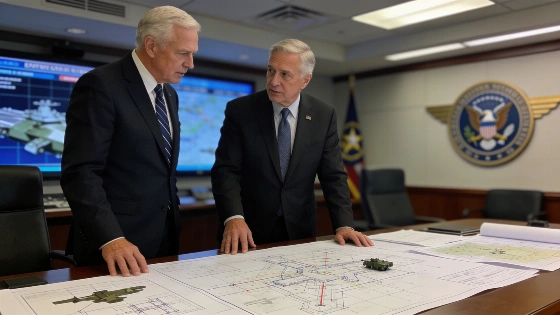
Inside the Pentagon, a small team now holds the reins on how the U.S. military will buy, test, and deploy autonomous systems. Project Agincourt has shifted real power to DRPM-UxS, a new office with direct lines to top brass and a clear mandate: chart the course for a full Autonomous Warfare Command by October 2027.
DRPM-UxS is no paper tiger. The office controls autonomy strategy and resource decisions, and it can steer acquisition reforms across all branches. Owen West and Max Strasiser lead the charge, reporting straight to senior leadership and working with the services on force structure and requirements. The Pentagon has never had a single group with this much say over autonomy funding and procurement.
DRPM-UxS was established on June 29, 2026, and was granted authority over nearly all Pentagon unmanned systems programs, reporting directly to Deputy Secretary of Defense Steve Feinberg.
Project Agincourt officially kicked off on September 30, when Secretary of War Pete Hegseth ordered the Department to lay the groundwork for AUTOWARCOM by October 1, 2027. The memo gives DRPM-UxS the job of writing the implementation plan, recommending Joint Force investments, coordinating manpower, prototyping a new acquisition process, and updating leadership on progress. AUTOWARCOM remains a concept for now, but the machinery is moving toward a major shift in command structure.
Hegseth went public with AUTOWARCOM’s planned creation as a future four-star functional combatant command on September 30, 2026, setting a one-year clock for its formation. At that point, AUTOWARCOM had no commander or budget, and making it fully independent could require Congress to act, as detailed in a report by The Intercept.
DRPM-UxS will stay lean, with most acquisition money and execution still handled by the services. The president could create AUTOWARCOM under current authority, but would have to notify Congress within 60 days. A four-star commander would need Senate confirmation. Expanded budget and acquisition powers for AUTOWARCOM may force new legislation. For now, DRPM-UxS is up and running, already shaping how the Pentagon approaches autonomy.
The Project Agincourt memorandum tasked DRPM-UxS, together with the Chairman of the Joint Chiefs of Staff, to present an action plan and key milestones for AUTOWARCOM within 30 days of the directive.
Congress is moving in parallel. Section 917 of the Senate Armed Services Committee’s FY27 NDAA calls for a U.S. Robotic and Autonomous Systems Command (RASCOM) with its own budget and operational test authority. RASCOM would echo much of Project Agincourt’s vision, but with tighter limits on acquisition powers. Whether this language survives the NDAA process is still up in the air.
The Army has already started to act. On October 1, Acting Secretary Adam Telle ordered the creation of the U.S. Army Futures and Autonomous Systems Command, new autonomous force structures, a Portfolio Acquisition Executive for Autonomy, and expanded robotics career fields. The Army is pushing to field autonomous fires, combat vehicles, watercraft resupply, breaching systems, reconnaissance, surveillance, target acquisition, and manned-unmanned teaming by FY28.
Three groups now anchor the Pentagon’s autonomy drive: DRPM-UxS for tech development and testing, Joint Task Force Autonomous Warfare (JTF-AW) for operational testing and deployment, and service-level acquisition offices for procurement. The plan is to fold autonomous systems into existing service structures, not replace them. New autonomy-focused leadership will work alongside the services’ own teams.
Project Agincourt signals a break from the Pentagon’s old, scattered approach to autonomy. The question is whether DRPM-UxS and its successor can cut through the layers of bureaucracy and deliver fast, effective integration of autonomous systems. If Congress grants the needed authorities, the U.S. military will face a new era in how it develops and fields autonomous capabilities. The next move depends on legislative action and sustained momentum inside the Pentagon.