
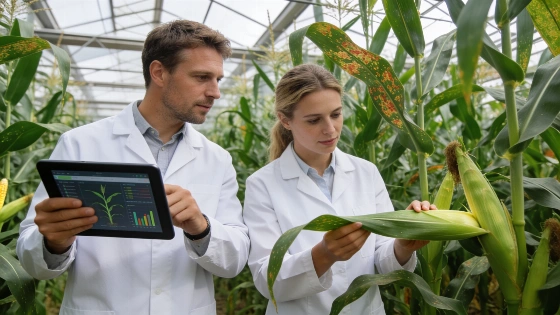
European farming is about to see a big shift. Vylor and Rainbow Crops have announced a partnership to push corn genetics further than ever before. Their goal: use artificial intelligence and multiplex gene editing to build corn hybrids that can handle heat, drought, and floods.
Vylor holds more than 4,000 germplasm patents and over 2,000 biotechnology patents, highlighting the scale of its innovation pipeline ahead of the spin-off.
"Rainbow Crops’ AI-enabled multiplex gene editing capabilities will allow us to make hundreds of gene edits simultaneously, while validating performance in state-of-the-art phenotyping facilities as well as through field trials," said Mat Muller, who will lead Vylor Edge. The aim is simple: create plants that can survive disease and extreme weather, and put Vylor at the front of this new science by using Rainbow Crops’ technology.
Rainbow Crops’ Trait Foundry™ is not just a buzzword. The platform mixes AI, multiplex genome editing, precision breeding, and automated phenotyping. It is built to tackle tough traits controlled by many genes—traits like drought tolerance and plant strength that have been hard to improve with old breeding methods. CEO and co-founder Giacomo Bastianelli points to early work in corn as proof that the platform can speed up progress on these complex traits.
Corteva’s official materials confirm that Vylor’s strategy is not limited to corn. The company is also developing dedicated technology platforms for soybean and wheat, reflecting a broad R&D commitment to crop improvement.
Corteva invested in Rainbow Crops through its Corteva Catalyst platform. This investment will move to Vylor Edge after the spin-off, tying the companies even closer. Vylor’s bigger plan is to lead in genetics and biotech, with new platforms for soybean and wheat as well as corn.
For European farmers dealing with wild weather and rising costs, corn hybrids that use resources better and give higher yields could be a real lifeline. The big question is whether this AI-powered, multiplex gene editing can deliver outside the lab and in real fields. If it works, Vylor and Rainbow Crops will set a new bar for crop genetics. The rest of the industry will have to keep up or risk falling behind.