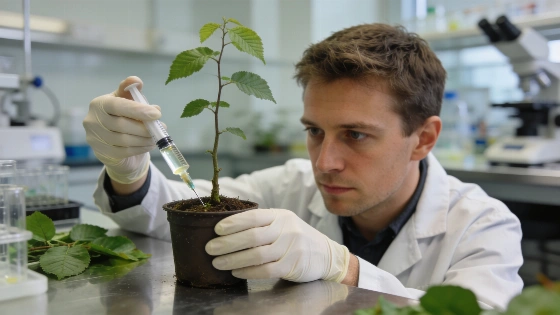
The UK’s biggest biotech experiment is underway. The Advanced Research and Invention Agency (Aria) has launched a £54 million programme to see how far science can help native wildlife adapt to climate change. Fourteen research teams have landed an initial £30 million in public grants. Their goal: build tools that could change the fate of species threatened by global warming and disease. As The Guardian reports, the programme runs until 2030. It is focused on research and tool development, not on releasing gene-edited animals or plants into the wild during this period.
A recent peer-reviewed study built a European ash pangenome from 50 trees, revealing over 3,400 dispensable genes and providing a stronger genomic basis for ash-dieback resistance research.
Yannick Wurm, who leads Aria’s accelerated adaptation programme and is a professor of evolutionary genomics at Queen Mary University, London, says the work is a response to a world where "natural environments are changing so rapidly… that many species can no longer adapt quickly enough." He compares these biotech tools to the mRNA vaccines that changed human medicine, but for wild plants and animals.
At the University of Exeter, one team is using Crispr-Cas9 gene editing on the endangered swallowtail butterfly. They want to make it more resistant to common insecticides. The University of Exeter says the project also covers bumblebee immunity and new gene-editing methods for adult insects. This could open up more ways to use genetics in conservation.
A separate report on ash-dieback research identified 211 genes potentially associated with resistance, including 16 genes found only in some individual trees, highlighting the value of natural genetic variation for future breeding or biotechnological interventions.
For amphibians, the Boston-based Cultivarium lab is working with Imperial College and Queen Mary University. They are engineering bacteria that live on newt skin to make proteins that "bind and stop" the deadly chytrid fungus. "We’re not genetically engineering the amphibian; rather what we’re trying to do is we’re trying to give them a shield," says Cultivarium co-founder Henry Lee.
But these projects come with big ethical and ecological risks. Using gene editing and synthetic biology in conservation is still highly controversial. At last year’s International Union for Conservation of Nature (IUCN) congress, more than 90 NGOs warned that these technologies could disrupt natural systems in ways that can’t be reversed. The IUCN set strict global rules for synthetic biology, and Aria’s own ethics code follows them. Marie-Claire Cordonier Segger, who chairs Aria’s ethical and social responsibility committee, says none of these experimental solutions will be released into the wild during the programme, which runs until 2030. All work stays in secure labs.
Aria itself has drawn fire before. The agency was set up by Dominic Cummings to fund "crazy" ideas and boost Britain’s science sector. It has been criticized for backing geoengineering and sending millions in taxpayer money to US tech firms. This month, its chair Matt Clifford quit after taking a job with Anthropic, the AI chatbot company, raising questions about a "clear conflict of interest."
Chris Thomas, who founded the Leverhulme Centre for Anthropocene Biodiversity at the University of York, sees potential in these projects but warns their real-world impact may be "modest" and hard to track. The chytrid fungus has already wiped out 90 amphibian species, but some populations have developed natural resistance. Making one species stronger could shift the balance for others in ways we can’t predict. Thomas says it’s "probably pretty naive" to think these interventions alone can stop biodiversity loss.
Moving from lab to field will take more than scientific proof. It will need approval from the Department for Environment, Food and Rural Affairs, which tightly controls genetically modified organism releases. Projects that show results in the first two years could get a share of another £24 million. Wurm hopes even a few breakthroughs could be "world-changing," but he admits the biggest challenge is still reversing the human-driven forces behind environmental change. These biotech projects are a last resort when traditional conservation is not enough.
Britain’s accelerated adaptation programme is a high-stakes bet on what biotech can do—and what it can’t. If these projects work, they could change the rules for conservation. But the real question is whether precision gene editing can actually help species survive, or if the promise of biotech will stay locked in the lab while climate and disease keep moving ahead.