
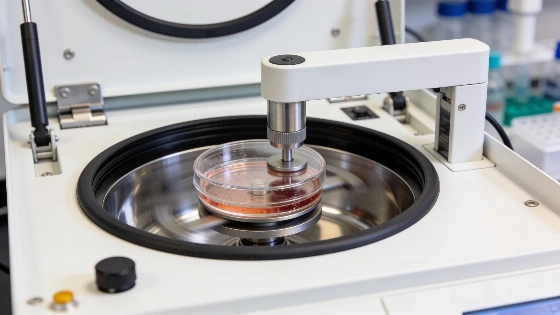
Gravity is no longer a given for researchers at the Department of Physics at New York University. In their lab, a random positioning machine (RPM) sits inside a cell incubator. This setup lets human cells experience simulated microgravity—something that used to be possible only in space.
After 24 hours of simulated microgravity, human-cell nuclei became larger, but genome organization and motion remained stable, with no detectable DNA damage reported.
The video is under embargo and only authorized viewers can see it. It shows the RPM running inside the incubator. The footage is only for use with the related study, which shows how tightly controlled this research is.
The broader impact for space biology and medicine is still to be seen, but bringing this machine into the lab is a big step. The RPM lets scientists test how cells handle stress and adapt when gravity is missing, just like in orbit. According to a detailed report by Phys.org, the device rotates cell dishes along two separate axes and follows a 3D path to copy weightlessness. The NYU team also built special algorithms to cut down on fluid movement that could mess up the results.
Simulated-microgravity cell systems, including random positioning machines and clinostats, are now recognized as standard platforms for life-science experiments, enabling researchers to study gravity's impact on cells without the need for orbital flight.
A 2026 NASA Spaceline review points out that microphysiological cell culture systems are now built for simulated microgravity and often run on random positioning machines or clinostats. This shows a shift in space-life-science research. More labs are using these setups to study how cells react to changes in gravity, cutting down on the need for expensive and complicated missions in orbit.