
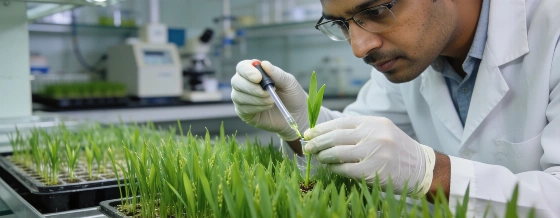
For the first time, scientists have shown that an enzyme designed by artificial intelligence can efficiently edit plant genomes. At ICAR-Central Rice Research Institute in Cuttack, researchers tested Plant OpenCRISPR-1 (POC1), a genome-editing tool based on the AI-generated nuclease OpenCRISPR-1, and found it works well for gene editing in rice.
Until now, plant genome editing has depended on proteins taken from bacteria and other microbes. The ICAR-CRRI team’s results show that AI-designed nucleases can also work inside plant cells. Their POC1-based tools performed gene knockout, base editing, and prime editing in rice, with results similar to the widely used SpCas9 system. A September 2026 review in Plant Physiology notes that plant genome editing is moving beyond traditional bacterial nucleases, and AI-designed CRISPR tools are now part of the standard toolkit for plants.
Recent studies show that prime-editing systems in rice can reach up to 96% efficiency for specific PAM contexts and up to 68% for homozygous mutations, highlighting the remarkable precision now achievable in plant genome editing.
The researchers went further than simple gene disruption. They created POC1 variants for precise base and prime editing, allowing single-letter DNA changes aimed at crop improvement. These tools were tested on several rice genes, where they successfully disrupted genes and rewrote genetic sequences at single-base resolution in transformed rice plants. Other reports confirm that prime and base editing technologies in rice are advancing quickly, with new tools reaching high editing efficiencies for targeted gene changes.
By using an open-source, AI-designed enzyme, the team has made these tools more accessible for both academic and commercial users. OpenCRISPR-1 is expected to be freely available for research and licensing, making it a practical alternative to proprietary genome editors. Independent analyses point out that open AI-designed editors are seen as more accessible than closed platforms, but stress the need to confirm their effectiveness and regulatory fit before they are widely used in agriculture.
The study, accepted by the journal New Phytologist, marks a step forward for India’s work in crop improvement. The POC1 platform could speed up the development of rice varieties with better grain quality, stress tolerance, nutrition, and disease resistance—without permanently adding foreign genes. Field trials in India have already shown that gene-edited rice varieties such as Pusa DST Rice1 can increase yields by 9.66–30.4% under saline and alkaline conditions, supporting the case for new genome editors, as described in a 2026 Nature report.
As of September 2026, the topic of AI-designed genome editors for crop engineering is not only a focus of laboratory research but is also being actively integrated into regulatory frameworks, marking a shift toward real-world implementation and oversight.
Frontiers in Plant Science
This research, funded by the Indian Council of Agricultural Research, shows that India is not only adopting but also helping shape the use of artificial intelligence in genome editing and agricultural science. The successful use of AI-designed genome editors in rice suggests that future crop engineering will rely on open, programmable, and precise molecular tools, moving beyond the limits of natural enzymes and proprietary systems.