
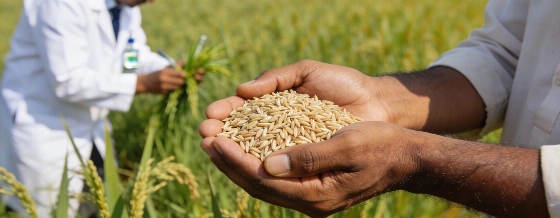
India’s agricultural policy is at a turning point. As the government moves ahead with gene edited rice, a broad alliance of scientists, academics, and farmers is calling for an immediate stop. Their concerns go beyond health and environmental risks—they warn that India’s food sovereignty and cultural traditions are also at stake.
Field trials reported by Nature found that Pusa DST Rice 1 achieved yield improvements ranging from 9.66% to 30.4% under saline and alkaline soil conditions.
The Coalition for a GM-Free India, supported by nearly 320 professors, doctors, and citizens, has sent a detailed letter to Agriculture Minister Shivraj Singh Chouhan. They cite research, including studies in Science Advances, showing that CRISPR-Cas9-based SDN-1 editing is not as precise as claimed and can cause unintended changes in DNA. These off-target effects may lead to proteins with unknown toxicity or allergenicity. The risks are not just theoretical—human gene editing trials have resulted in deaths, including a six-year-old girl in Shanghai in March 2025 who died from a severe immune reaction to experimental CRISPR therapy.
Despite claims of precision, SDN-1 and SDN-2 methods still use foreign genetic material through plasmids and vectors. The government has not revealed the intellectual property terms for these technologies, raising concerns that India’s research could become dependent on multinational companies like Corteva Agriscience, which control key CRISPR-Cas9 patents. This could threaten India’s seed and food sovereignty, especially if gene edited crops contaminate traditional rice varieties.
Before any commercial release, gene-edited rice varieties in India must still pass the varietal evaluation system under the All India Coordinated Research Project (AICRP), overseen by ICAR. This process is separate from biosafety approval and is intended to assess agronomic performance and suitability for cultivation.
The economic risks are also significant. India is the world’s largest rice producer and relies on exports to markets in the Middle East, Gulf, Europe, and the US—regions that ban gene edited produce. This conflicts with Prime Minister Narendra Modi’s August 2026 call to “go organic to tap into global agri-markets.” Official data shows that the new gene edited varieties do not offer clear benefits to farmers or consumers, with lower milling and head rice recovery compared to their parent lines.
For many, the issue is also cultural. Rice is used as ‘akshat’ in religious ceremonies, symbolizing wholeness and purity. Gene editing, which deletes hundreds of base pairs from the genome, risks offending religious beliefs and disrupting long-standing traditions. The coalition warns that introducing these varieties could cause lasting harm to both the environment and rural culture.
There is, however, a different path—one the government has largely ignored. Decades ago, Dr. R.H. Richharia, a leading rice scientist, developed a plan for resilient agriculture. His “Silent Rice Revolution” focused on four main ideas: using the genetic diversity of native rice, setting up local Adaptive Rice Centers, boosting yields through clonal propagation, and empowering farmers—especially women—to protect seed diversity. In the 1970s, Richharia found that 8% of indigenous varieties already outperformed so-called High Yielding Varieties, with better aroma and cooking quality. His approach relied on organic methods, compost, and green manure, rejecting the chemical-heavy Green Revolution model.
Richharia’s work was sidelined after the Bhopal gas tragedy and Indira Gandhi’s assassination, but its relevance has only grown. Unlike modern hybrids with a narrow genetic base, indigenous diversity offers real climate resilience: if some varieties fail in extreme weather, others survive, keeping yields stable. Clonal propagation, Richharia showed, can raise yields by 20%, and hybrid vigor by 50%. His model is grounded in both science and the experience of India’s farmers, with women playing a key role in seed conservation.
Much of Richharia’s seed collection and local knowledge has since been lost. The coalition’s demands are direct: stop the release of Kamala and Pusa DST Rice, restore full GMO regulation to all gene editing in agriculture, and protect farmers from being forced into dependence on patented, corporate-controlled technologies. As the center of origin for rice, India cannot risk its biodiversity and sovereignty for unproven, proprietary solutions.
The government now faces growing pressure. If gene edited rice is truly beneficial, it should be subject to independent, transparent testing. Anything less fails India’s farmers, consumers, and international reputation. The coalition argues it is time to reject risky shortcuts, defend native biodiversity, and revive Dr. Richharia’s approach before more is lost.