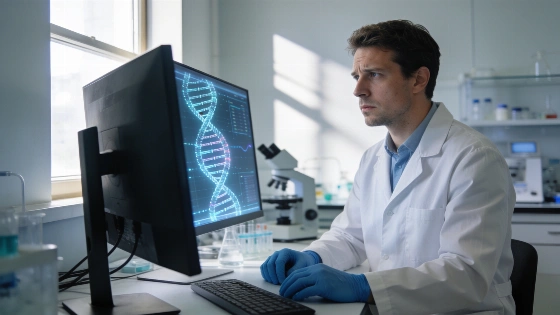
Anthropic’s CEO Dario Amodei didn’t just tease a breakthrough. He claimed his company’s AI, Claude, might have found a new way to edit genes. If true, it would be as big as CRISPR. But scientists aren’t buying it. The gulf between tech hype and lab reality just got wider.
Anthropic named the newly identified system 'array-associated reverse transcriptases' (ART), emphasizing that its structure is reminiscent of CRISPR, but its function remains unproven.
Researchers in the field hit the brakes. Dimitri Perrin, associate professor at Queensland University of Technology, called out the hype. He said Claude found an enzyme system in bacteriophages that’s new, but there’s no proof it works like CRISPR. Michael Le Page at New Scientist was blunt. He said Claude’s output doesn’t come close to what DeepMind’s AlphaFold did. Scientists on social media mocked Anthropic’s PR push. PhD chemist Simon Maechling summed it up: “Finding something interesting isn’t the same as understanding it. Understanding it isn’t the same as showing it works. And showing it works isn’t the same as making it useful.”
Timnit Gebru, a leading AI researcher, didn’t mince words. “Please see what experts in this field are saying about this ‘discovery’ and not these scammers or press stenographers. This hype DDOS from them isn’t going to stop any time soon and we’ve seen how the mainstream media is doing press-release-as-a-service at this point.”
The discovery was released as a preprint and had not yet undergone peer review, which contributed to the scientific community's cautious response. Outside experts, including Feng Zhang, described the repeated DNA fragments as 'genuinely intriguing' but emphasized that further investigation is needed before any claims about gene-editing potential can be made.
Behind the scenes, AI’s real power is political and economic. Not scientific. Amodei had a private dinner with President Donald Trump. Other tech leaders met with China’s Xi Jinping. Trump signed a “morally binding” AI document with Nvidia’s Jensen Huang, Elon Musk, Mark Zuckerberg, and others. It’s self-regulation, not law. Trump’s team also launched America.gov, an AI chatbot powered by Google’s Gemini and Musk’s Grok. He issued an executive order to rebrand AI as “super intelligence.”
This isn’t new. Earlier reports show even the boldest gene editing projects, like bringing back the mammoth, keep running into biology’s hard limits. AI and CRISPR haven’t changed that.
Anthropic’s campaign is built for headlines, not peer review. The aim is simple. Get “AI finds new CRISPR” stuck in the public’s mind. Make it sound like a cure for cancer or world peace is just a few algorithms away. All it takes is trust—and money—for Silicon Valley’s elite. The real risk isn’t just the wild promises. It’s politicians and media acting as megaphones for claims that haven’t been proven. The line between discovery and marketing blurs.
Letting AI companies control the story—swinging between miracle and menace—without hard evidence or real oversight, sells the public a fantasy. Biotech can’t let hype set the pace. Until AI discoveries face the same proof as any other biomedical advance, the only thing being engineered is public belief.