
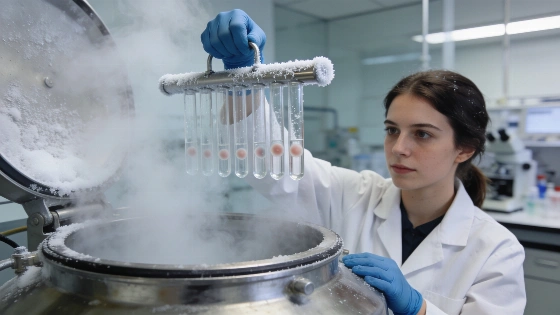
Rows of frozen embryos sit in Origin Genomics’ New York City lab. Each one carries a family’s genetic history. CEO Cathy Tie believes gene editing can finally break the cycle of inherited disease. Her team wants to show that editing human embryos can be safe. If they succeed, families could have children without the risk of passing on serious genetic mutations.
Current U.S. law strictly prohibits the use of gene-edited embryos for reproduction, and no company has received clinical approval to create children from genetically modified embryos as of September 2026.
The legal roadblocks are huge. In the U.S., it is illegal to use gene-edited embryos to make babies. The memory of He Jiankui, the Chinese scientist jailed after announcing the first CRISPR-edited babies, still hangs over the field. Most scientists are cautious. They warn that even new tools like prime editing and base editing might not prevent unwanted, heritable mutations. Robin Lovell-Badge from the Francis Crick Institute says, “It’s giving people false hope. And I am concerned that they are rushing ahead too fast and making some mistake, which would then set back the field.”
Inside the lab, Tie shows how the process works. Her team extracts stem cells from donated embryos. They test their own gene editors—some built with artificial intelligence—on cells with disease-causing mutations. Under the microscope, green fluorescent cells show if the editor has entered and possibly fixed the mutation. Tie calls this the “very first step.” She hopes it will lead to a platform that can stop diseases like Huntington’s, cystic fibrosis, hereditary cancers, and Tay-Sachs from being passed down.
U.S. regulatory frameworks draw a sharp distinction between somatic gene editing, which is permitted for treating individual patients under FDA oversight, and germline editing, which affects embryos or reproductive cells and is subject to far stricter limitations.
Tie says Origin Genomics does not want to enhance traits or create designer children. She promises a slow, careful approach. She says there will be independent oversight and full transparency. “This is a very powerful technology. Safety must come first,” she says. Tie distances herself from the Chinese experiment and says Origin’s work is completely separate.
The law is still against her. Tie wants to gather enough proof to convince regulators and lawmakers to rethink the ban on gene-edited embryos for reproduction. “If you have a technology that can be proven to be safe, and it can help hundreds of millions of people that suffer from these diseases, it is unethical to not pursue this research,” she says. She wants doctors, regulators, bioethicists, and patient advocates to work together on how to use the technology responsibly.
Origin Genomics is not the only player. Startups like Preventive in San Francisco are also working on embryo gene editing. Some academic researchers worry that private companies could drive unregulated clinics overseas. R. Alta Charo calls this “genome-editing tourism.”
Origin Genomics has forced the debate into the open. The company is challenging the rules. Now, society must face the ethical, scientific, and legal questions. As more data comes in, lawmakers and scientists will have to decide if the hope of ending inherited disease is worth the risk of changing the human germline. One thing is clear. The future of gene editing in reproduction will not be decided behind closed doors. It will depend on the evidence, the debate, and the willingness to ask if medicine is ready for this change.