
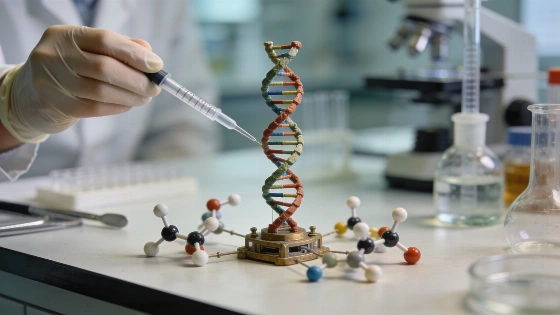
Life may have started with a single RNA molecule that could copy itself and make proteins. Not a messy mix of fragments. That is the core of the riboreplisome hypothesis. This model questions old ideas about how genetic systems and translation began.
The proposal lays out 12 evolutionary steps. It starts with short RNA pieces joining into longer, active molecules. At first, evolution did not follow Darwinian rules. But soon, natural selection took over. The riboreplisome moved from a basic replicase to a proto-ribosome that could make short peptides. Only two steps need non-Darwinian changes. The other ten follow standard evolutionary selection. The authors back this with quantitative modeling.
In modern biology, the ribosome is itself a ribozyme—its catalytic core is made of RNA, not protein, supporting the idea that ancient RNA molecules could both store information and catalyze reactions.
From RNA fragments to the ultimate RNA machine
The riboreplisome idea changes how we see early molecular evolution. First, short RNA fragments join to form a longer molecule with replication ability. Next, the molecule uses complementarity to copy only itself. This sets up a selective environment. These two steps, both non-Darwinian, clear the way for Darwinian evolution.
After that, the riboreplisome gains new tricks. It can modify its own 3’ end. It uses aminoacylation from pre-charged nucleotides. This boosts how well it copies itself and makes it more stable. Now, the riboreplisome acts as a full genetic system. It starts to prefer certain amino acids. It develops the ability to recharge aminoacyl-nucleotides. Later, aminoacylated RNA fragments begin to donate amino acids through a proto-peptidyl transferase center. Short peptides form at the 3’ end.
This design keeps genetic and catalytic parts close together. The riboreplisome gets an estimated sixfold evolutionary edge over systems with many RNA parts. Staying close means more efficient work. It also helps block parasitic 'cheater' molecules that would steal resources. But this sixfold advantage is still just a theoretical number. No independent experiments or major peer-reviewed reviews have confirmed it yet, as a recent arXiv preprint points out.
Current mainstream scientific frameworks describe the transition from an RNA world to a system where DNA, RNA, and proteins have divided roles in information storage, transmission, and catalysis. This division of labor is widely used in modern textbooks and reviews as the foundational logic for understanding molecular evolution, rather than a consensus on a single 'supermolecular' ancestor.
Implications for the genetic code and cellular evolution
The riboreplisome hypothesis tackles a big question. How did replication and translation—two linked processes—evolve together? The model says one molecule did both jobs. This removes the need for separate systems that had to co-evolve. It also explains why ribosomes translate the genetic code in all life forms.
The idea goes further. It suggests ribosomal, transfer, and messenger RNAs all came from this ancient molecule. The push to compartmentalize, which led to the first cells, may have started as a way to protect and fine-tune the riboreplisome’s combined functions. The Pearson Cell Biology Study Guide notes that RNA’s ability to store genetic information and catalyze reactions is central to the classic 'RNA world' hypothesis. The ribosome’s RNA-based catalytic core is strong evidence for this view.
The original riboreplisome is probably lost to time. Still, the authors think traces might survive in modern biological RNA. Finding or rebuilding riboreplisome-like molecules could push origin-of-life research and synthetic biology in new directions. This challenge is similar to what researchers face in other big biotech projects, like those reported earlier in gene editing and de-extinction. Biology is rarely simple.
The riboreplisome model is clear and quantitative. It maps a possible, selection-driven path from simple RNA chemistry to the complex translation machinery we see today. This gives a real alternative to the usual 'RNA world' or 'protein world' stories. If future work finds molecular fossils or builds synthetic versions, this idea could change how we see life’s first steps and the logic behind biological evolution.