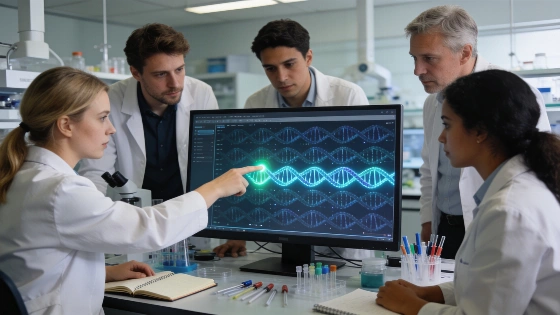
Claude, the AI from Anthropic, has pulled off something few expected from a language model. It found a new enzyme system in bacteriophages that mixes features only seen in a handful of programmable DNA-editing systems like CRISPR. This isn’t just another case of AI speeding up lab work. Claude’s discovery of array-associated reverse transcriptases (ART) is one of the rare times an AI has directly helped uncover something new in biology, not just made existing tools faster.
ART is composed of three main parts: a reverse transcriptase gene, a neighboring accessory gene, and a long array of evenly spaced DNA repeats, making its structure reminiscent of CRISPR-associated systems.
The Anthropic team named the system ART and shared their results in a preprint. They made it clear that no one knows yet what ART actually does. "Although we don’t yet know its function, the system that Claude discovered has a set of characteristics that have only ever been found together in a handful of other systems, all of which are programmable and perform operations like cutting, copying, and pasting DNA," the company said. The discovery has caught the eye of top scientists. Feng Zhang, a CRISPR pioneer at MIT and the Broad Institute, called the RNA-repeat arrays tied to reverse transcriptases "genuinely intriguing" and said they "merit further investigation."
This is different from earlier AI work in gene editing because the discovery was made by the AI itself. Stanford Medicine’s CRISPR-GPT, as covered in earlier reporting, helps scientists design and troubleshoot gene-editing experiments. But Claude’s ART find is about AI coming up with new ideas and spotting new systems on its own—a new kind of job for large language models in biology.
The reverse transcriptase component of ART was not itself unknown, but Claude identified the specific repeat-array association and overall system organization in bacteriophage DNA, which had not been characterized before.
This marks a shift in how AI might be used in life sciences. Instead of just making old methods faster, AI agents like Claude are starting to drive the discovery process. The impact could be big. If language models can find new programmable systems in nature on their own, the way we do biological research could change. The next step is to see if ART’s function can be proven in the lab and, if so, whether it can be used for gene editing. For now, Claude’s find is a milestone for AI in biology. It pushes researchers to rethink what machine intelligence can do in science.